Accelerating Into the Future: From 0 to 1 GeV in Centimeters
July 22, 2008
By exciting electric fields in plasma-based waveguides, lasers accelerate electrons in a fraction of the distance conventional accelerators require. The Accelerator and Fusion Research Division’s LOASIS program, headed by Wim Leemans, has used 40-trillion-watt laser pulses to deliver billion-electron-volt (1 GeV) electron beams within centimeters. Leemans looks ahead to BELLA, 10-GeV accelerating modules that could power a future linear collider.
( Download Podcast | Presentation )
BELLA: The Next Stage in Laser Wakefield Acceleration
April 15, 2008Contact: Paul Preuss
For over a year, the LOASIS group led by Wim Leemans, of Berkeley Lab’s Accelerator and Fusion Research Division (AFRD), has held the world record for laser-wakefield acceleration, accelerating high-quality electron beams to energies exceeding 1 GeV, a billion electron volts, in a distance of just three centimeters. Now Leemans and his colleagues are [...]
Terahertz Radiation from Tabletop Accelerators: A Tool for Measurement and Experiment
June 21, 2007Contact: Paul Preuss, paul_preuss@lbl.gov
The nickname “tabletop accelerator” may be a metaphor, but laser wakefield accelerators are still remarkably compact by comparison with traditional particle accelerators whose length is measured in kilometers.
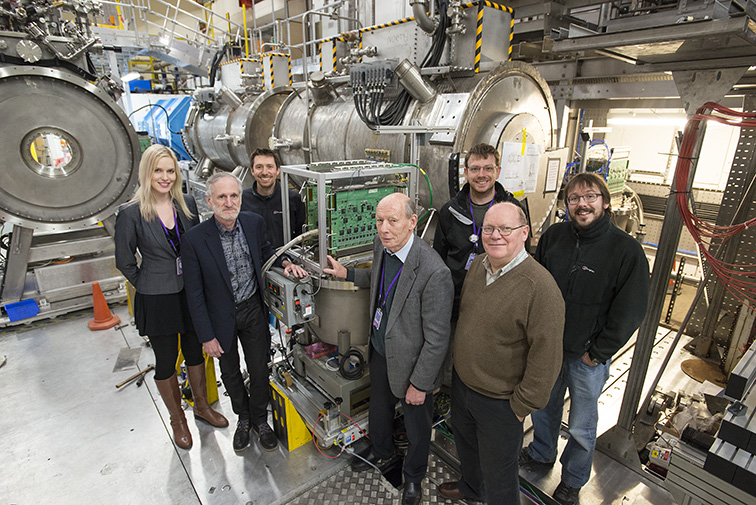
Wim Leemans and Jeroen van Tilborg with the LOASIS laser wakefield acceleration experiment. (Photo Roy Kaltschmidt, CSO)
Since 1995, Wim Leemans and his LOASIS group [...]
Read More>Keeping in Sync at a Quadrillionth of a Second
June 21, 2007Contact: Paul Preuss, paul_preuss@lbl.gov
Femtosecond lasers have been around since the 1980s, their pulses measured in quadrillionths of a second (10-15 second). The turn of the 21st century saw the achievement of attosecond pulses, lasting mere billionths of a billionth of a second (10-18 second). Now particle accelerators, and experiments that depend on them, [...]
Read More>VENUS Achieves Record-Breaking Beams
February 22, 2007Contact: Paul Preuss, paul_preuss@lbl.gov
VENUS, the Versatile ECR Ion Source for Nuclear Science installed at the 88-Inch Cyclotron, recently achieved record currents of highly charged uranium ions, an important milestone in demonstrating that superconducting technology can meet the demands of future heavy-ion accelerators.
VENUS, the Versatile ECR Ion Source for Nuclear Science, feeds highly charged ions to [...]
Read More>Lawrence Berkeley National Laboratory Opens the National Center for X-ray Tomography
October 13, 2006Contact: Lynn Yarris (510) 486-5375, lcyarris@lbl.gov
BERKELEY, CA — The National Center for X-ray Tomography (NCXT) has officially been dedicated at the U.S. Department of Energy’s Lawrence Berkeley National Laboratory (Berkeley Lab). Located at Berkeley Lab’s Advanced Light Source (ALS), this new center features a first-of-its-kind x-ray microscope that will enable scientists to perform “CAT [...]
Read More>From Zero to a Billion Electron Volts in 3.3 Centimeters
September 25, 2006Contact: Paul Preuss, (510) 486-6249, paul_preuss@lbl.gov
BERKELEY, CA — In a precedent-shattering demonstration of the potential of laser-wakefield acceleration, scientists at the Department of Energy’s Lawrence Berkeley National Laboratory, working with colleagues at the University of Oxford, have accelerated electron beams to energies exceeding a billion electron volts (1 GeV) in a distance of just 3.3 [...]
Read More>A Model Citizen
May 30, 2006Contact: Paul Preuss, paul_preuss@lbl.gov
Those who wander Berkeley Lab’s hallways or surf the Lab’s intranet are familiar with the art of Robin Lafever: spectacular images of the proposed SuperNova/Acceleration Probe (SNAP) satellite; the Silicon Vertex Tracker built for the BaBar detector at the Stanford Linear Accelerator Center’s B-Factory; GRETINA, the most sensitive gamma-ray detector ever devised, [...]
Read More>
Subscribe
Berkeley Lab YouTube channel