LBNL Masthead A-Z Index Berkeley Lab masthead U.S. Department of Energy logo Phone Book Jobs Search
Search the News Center:
Posts Tagged ‘astrophysics’

Planck Mission Updates the Age of the Universe and What it Contains

March 21, 2013

At a March 21 NASA telephone news conference, scientists from the U.S. team participating in the European Space Agency’s Planck mission to map the cosmic microwave background (CMB) discussed Planck’s first cosmological results, including some surprising news. For one thing, the universe is 13.82 billion years old, a hundred million years older than previously thought, [...]

MORE>

The Last Big Bump Before a Supernova Explodes

February 6, 2013

The Palomar Transient Factory (PTF) brings together universities, observatories, and one national laboratory to hunt for supernovae and other astronomical objects. At the National Energy Research Scientific Computing Center (NERSC) Berkeley Lab processes and stores the data from PTF’s surveys, which use the Oschin Telescope at Caltech’s Palomar Observatory.
On August 25, 2010, PTF’s “autonomous machine-learning [...]

MORE>

The Farthest Supernova Yet for Measuring Cosmic History

January 9, 2013

In 2004 the Supernova Cosmology Project used the Hubble Space Telescope to find a tantalizing supernova that appeared to be almost 10 billion light-years distant. But Berkeley Lab scientists had to wait until a new camera was installed on the Hubble years later before they could confirm the candidate’s identity and redshift as a Type Ia “standard candle.” The spectrum and light curve of supernova SCP-0401 are now known with clarity; it is the supernova furthest back in time that can be used for precise measurements of the expansion history of the universe.

MORE>

How do You Know if You Ran Through a Wall?

January 4, 2013

Researchers from Canada, California, and Poland have devised a straightforward way to test an intriguing idea about the nature of dark energy and dark matter. A global array of atomic magnetometers – small laboratory devices that can sense minute changes in magnetic fields – could signal when Earth passes through fractures in space known as [...]

MORE>

Gordon and Betty Moore Foundation Gives a Big Boost to BigBOSS

December 4, 2012

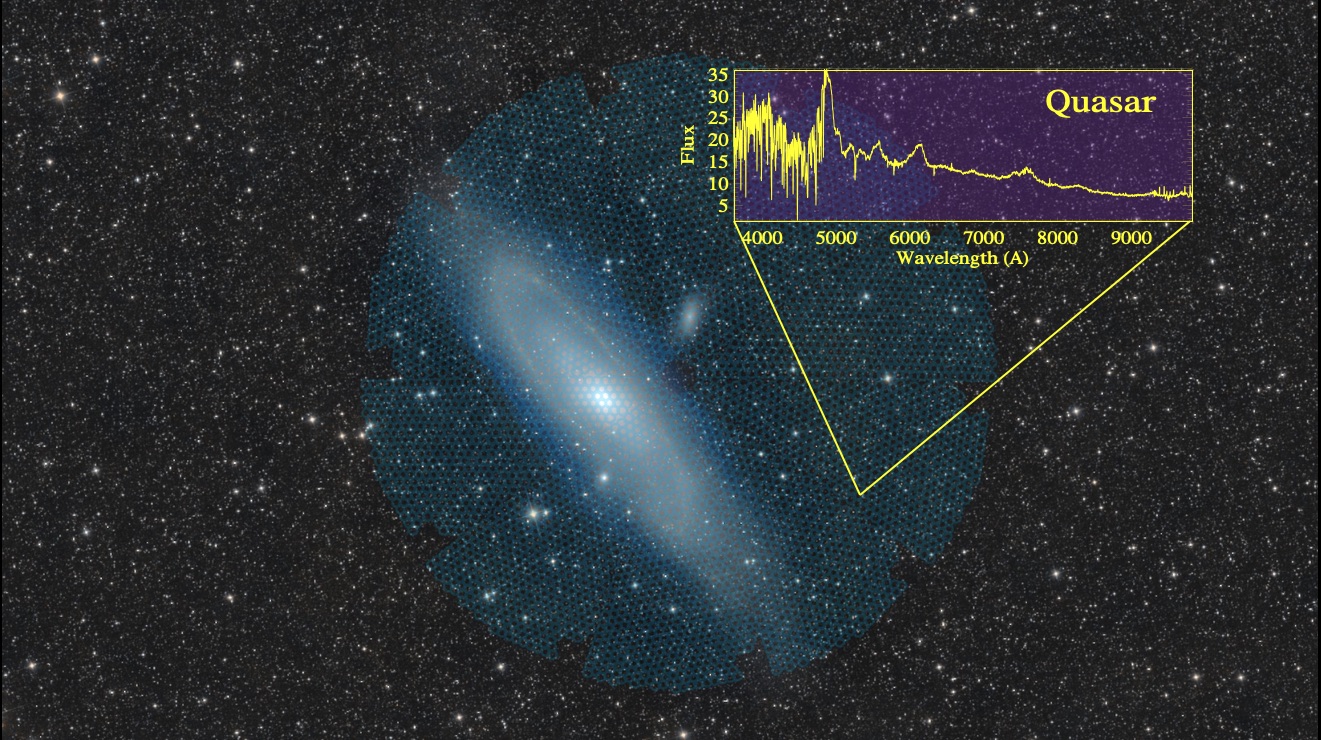
Through UC Berkeley and the Berkeley Center for Cosmological Physics, the Gordon and Betty Moore Foundation has made a $2.1 million grant to Berkeley Lab’s BigBOSS project. The grant funds the development of key technologies for modifying the 4-meter Mayall Telescope on Kitt Peak and constructing a precision instrument to study dark energy by mapping tens of millions of galaxies and quasars over the entire Northern Hemisphere sky.

MORE>

BOSS Quasars Unveil a New Era in the Expansion History of the Universe

November 12, 2012

By collecting tens of thousands of quasar spectra, the Baryon Oscillation Spectroscopic Survey (BOSS) has measured the large-scale structure of the early universe for the first time. Like backlights in the fog, the quasars illuminate clouds of hydrogen gas along the line of sight. No other technique can reach back over 10 billion years to probe structure at a time when the expansion of the universe was still decelerating and dark energy was yet to turn on.

MORE>

Crisis Looms as Berkeley Lab’s Last Main Road is Named for Nobelist Perlmutter

October 15, 2012

During the Open House Lecture Series on October 13 one of the last remaining unnamed roads on the Berkeley Lab site was christened for the 2011 Nobel Prize winner in Physics, Saul Perlmutter. There may be billions of stars in the sky but there aren’t many streets left to be named after Nobel Prize winners. When it comes to road names, the Lab’s future Nobelists could face a serious road shortage — one more reason we need a second campus.

MORE>

Berkeley Lab Sensors Enable First Light for the Dark Energy Camera

September 17, 2012

Mounted on a telescope high in the Andes, the Dark Energy Camera (DECam) saw first light September 12. DECam’s half-billion-pixel focal plane is made of Berkeley Lab CCDs, descended from sensors developed for high-energy physics by Berkeley Lab scientists and engineers. Highly sensitive to the near-infrared region of the spectrum, Berkeley Lab CCDs are an essential component of the most powerful dark-energy survey instrument yet made.

MORE>

The First Public Data Release from BOSS, the Baryon Oscillation Spectroscopic Survey

August 8, 2012

Now freely available to the public: spectroscopic data from over half a million galaxies up to 7 billion light years away, over a hundred thousand quasars up to 11.5 billion light years away, and tens of thousands of stars and other astronomical objects in the Sloan Digital Sky Survey’s Data Release 9. This data is just the first year and a half of observation by BOSS, the Baryon Oscillation Spectroscopic Survey led by Berkeley Lab scientists. BOSS is the largest spectroscopic survey ever made to measure the evolution of large-scale galactic structure.

MORE>

Latest Edition of the “Particle Physics Bible” Now Online

June 19, 2012

“The Review of Particle Physics,” a panorama of the world of high-energy and astroparticle physics known as “the PDG” for short, has been compiled and issued every two years since 1957 by the Berkeley Lab-based international Particle Data Group, now almost 200 scientists from 22 countries. The online version of the 2012 PDG has just been posted.

MORE>

A U.S. Department of Energy National Laboratory Operated by the University of California
UC logo
Questions & CommentsPrivacy & Security Notice