LBNL Masthead A-Z Index Berkeley Lab masthead U.S. Department of Energy logo Phone Book Jobs Search
Search the News Center:
Posts Tagged ‘cosmology’

Calculating What’s in the Universe from the Biggest Color 3-D Map

January 11, 2012

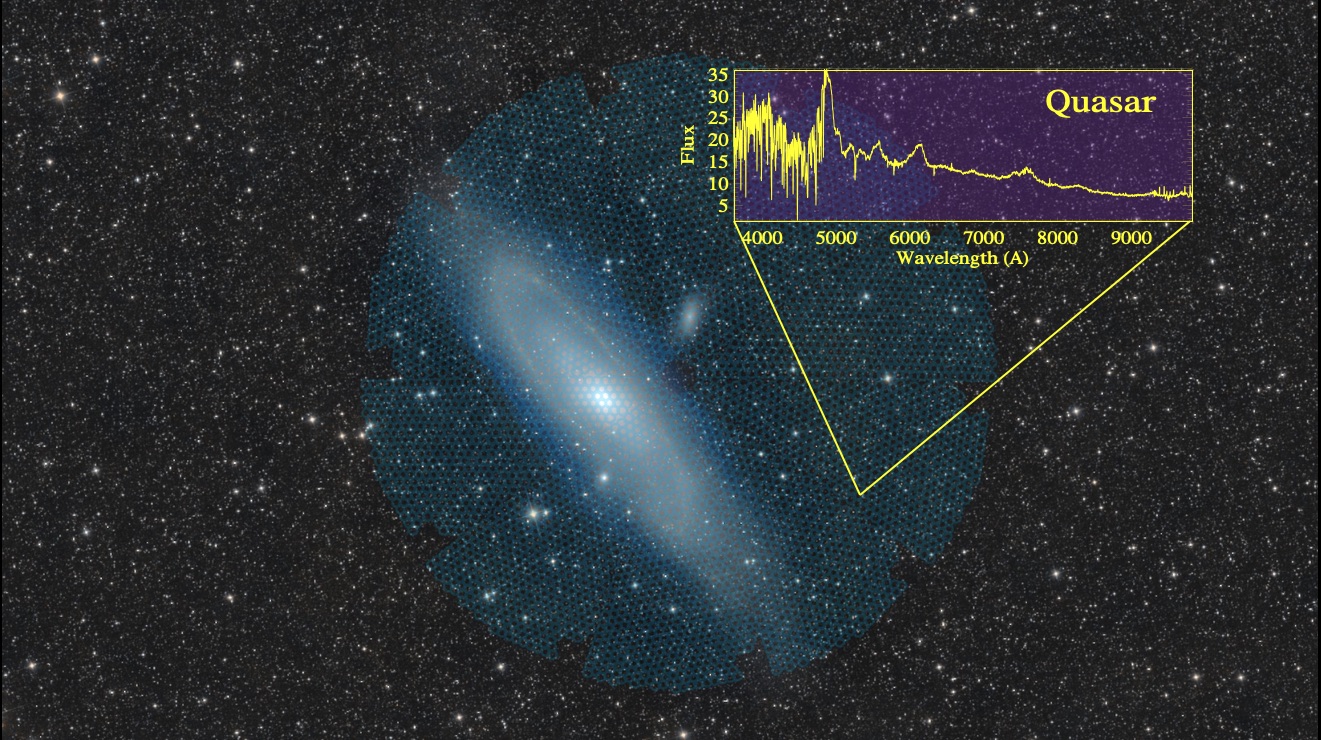
Berkeley Lab scientists and their colleagues in the Sloan Digital Sky Survey have used visual data from nearly a million galaxies to derive the most accurate calculation yet of how matter clumps together – from a time when the universe was only half its present age until now. The results yield cosmic rulers to measure how the universe has expanded and to determine how much dark matter, dark energy, and even hard-to-detect neutrinos it contains.

MORE>

Clearest Picture Yet of Dark Matter Points the Way to Better Understanding of Dark Energy

January 9, 2012

Two teams at Fermilab and Berkeley Lab have independently made the largest direct measurements of the invisible scaffolding of the universe, using the gravitational lensing effect known as “cosmic shear” to build maps of the distribution of dark matter. Their methods show that surveys with ground-based telescopes can measure cosmic shear with enough accuracy to aid in better understanding the mysterious space-stretching effects of dark energy.

MORE>

Closest Type Ia Supernova in Decades Solves a Cosmic Mystery

December 14, 2011

Even as the “supernova of a generation” came into view in backyards across the northern hemisphere last August, physicists and astronomers who had caught its earliest moments were developing a surprising and much clearer picture of what happens during a titanic Type Ia explosion. Now they have announced the closest, most detailed look ever at one of the universe’s brightest “standard candles,” the celestial mileposts that led to the discovery of dark energy.

MORE>

Grab your Binoculars to Glimpse a Cosmic Explosion!

August 31, 2011

Skywatchers — grab your binoculars and telescopes, and head for some clear dark skies. A new supernova has been discovered near the Big Dipper constellation. At a mere 21 million light-years away from Earth, a relatively small distance by astronomical standards, the supernova is appearing so bright that Earthlings may be able to see it with a good pair of binoculars over the next few weeks. The best time will be in the first few hours after sunset.

MORE>

Berkeley Scientists Discover an “Instant Cosmic Classic” Supernova

August 25, 2011

A supernova discovered yesterday is closer to Earth — approximately 21 million light-years away — than any other of its kind in a generation. Astronomers at Berkeley Lab and UC Berkeley who made the discovery predict that it will be a target for research for the next decade, making it one of the most-studied supernova in history.

MORE>

Measuring the Distant Universe in 3-D

May 1, 2011

The biggest 3-D map of the distant universe ever made, showing the distribution of intergalactic clouds of gas by using light from 14,000 galaxy-eating black holes over 10 billion light years away, has been announced by the Baryon Oscillation Spectroscopic Survey (BOSS), the largest survey in the third Sloan Digital Sky Survey. The result proves that the technique, never attempted before, can be used to study dark energy in the early universe.

MORE>

The Saga of the Dark Universe Finds a Spell-binding Bard

January 24, 2011

Excerpts from a review of Richard Panek’s “The 4 Percent Universe: Dark Matter, Dark Energy, and the Race to Discover the Rest of Reality,” published by Houghton Mifflin Harcourt on January 10: in relating the discovery of dark matter and dark energy, the author shows how physicists and astronomers at Berkeley Lab and UC Berkeley not only contributed to the study of dark matter but pioneered the techniques that revealed the existence of dark energy. Berkeley Lab scientists remain at the forefront of research into the nature of the dark universe.

MORE>

Searching for Dark Energy with the Whole World’s Supernova Dataset

April 21, 2010

The Supernova Cosmology Project’s Union2 compilation and reanalysis of decades of the world’s best supernova surveys, with the addition of six high-redshift supernovae, puts new bounds on possible values for the nature of dark energy. Einstein’s cosmological constant comfortably fits the data, but there’s still plenty of room at the top for dynamical theories.

MORE>

Measuring a Monstrous Supernova

March 23, 2010

Members of the Nearby Supernova Factory based at Berkeley Lab discovered and analyzed a rare Type Ia supernova whose progenitor star had a mass some two and a half times that of our sun – much more mass than a Type Ia progenitor should be able to accumulate before it explodes. The data they gathered is the most complete ever for such an unusual beast; only one model really fits, the merger of two white dwarf stars.

MORE>

Foiling an Attack on General Relativity

March 11, 2010

In an attempt to explain away invisible dark matter and dark energy, some theorists have offered new theories of gravity that try to improve on Einstein’s General Theory of Relativity. A new study inspired by the work of a Berkeley Lab cosmologist indicates that at least one of these new theories is wrong.

MORE>

A U.S. Department of Energy National Laboratory Operated by the University of California
UC logo
Questions & CommentsPrivacy & Security Notice