LBNL Masthead A-Z Index Berkeley Lab masthead U.S. Department of Energy logo Phone Book Jobs Search
Search the News Center:
Posts Tagged ‘energy’

E. Coli Bacteria Engineered to Eat Switchgrass and Make Transportation Fuels

November 29, 2011

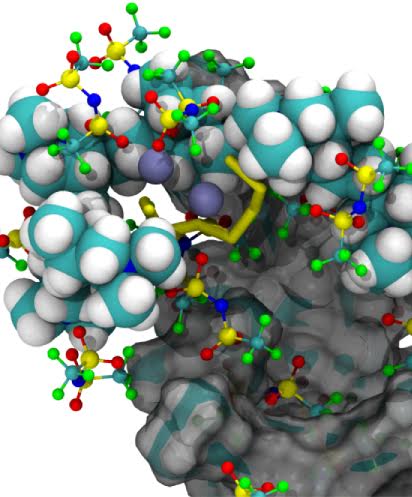
Strains of E. coli bacteria were engineered to digest switchgrass biomass and synthesize its sugars into gasoline, diesel and jet fuel. The switchgrass, which is among the most highly touted of the potential feedstocks for advanced biofuels, was pre-treated with ionic liquid, a key to the success of this study.

MORE>

On the Road to Plasmonics With Silver Polyhedral Nanocrystals

November 22, 2011

Berkeley Lab researchers may have opened the door to a simpler approach for the fabrication of plasmonic materials – one of the hottest new fields in high tech – by inducing polyhedral-shaped silver nanocrystals to self-assemble into three-dimensional millimeter-sized supercrystals of the highest possible density.

MORE>

A Corny Turn for Biofuels from Switchgrass:

November 18, 2011

Introducing a special corn gene into switchgrass was found to significantly boost the viability of the switchgrass biomass as a feedstock crop for advanced biofuels. The gene, a variant of the Corngrass1 gene, holds the switchgrass in a perpetual juvenile state, more than doubling its starch content and making it easier to convert its polysaccharides into fermentable sugars.

MORE>

Berkeley Lab Researchers Create First of Its Kind Gene Map of Sulfate-reducing Bacterium:

November 9, 2011

Critical genetic secrets of a bacterium that holds potential for removing toxic and radioactive waste from the environment have been revealed in a study led by Berkeley Lab researchers. The researchers have created a first-of-its-kind gene map of Desulfovibrio vulgaris, which can be used to identify the genes that determine how these bacteria interact with their surrounding environment.

MORE>

Berkeley Lab Research Sparks Record-Breaking Solar Cell Performances

November 7, 2011

Theoretical research by Berkeley Lab scientists has led to record-breaking efficiencies in solar cells. The research showed that, contrary to conventional scientific wisdom, the key to solar cell efficiency is not absorbing more photons but emitting more photons.

MORE>

Berkeley Lab to Build Cost Model for Fuel Cells

November 1, 2011

Fuel cells seem like an ideal energy source—they’re clean, efficient, silent and don’t require transmission lines. The hitch? They can be costly. Now scientists at Lawrence Berkeley National Laboratory (Berkeley Lab) hope to change that equation by building a sophisticated cost model that will take into account the total cost of ownership.

MORE>

How Energy Analysis Can Create More Bang For the Energy Research Buck

November 1, 2011

Scientists at Lawrence Berkeley National Laboratory (Berkeley Lab) are working on a wide variety of clean energy technologies—from biofuels to batteries to solar energy—but now these disparate efforts are being tied together with an in-depth and innovative analytical approach that will show which technologies are the most beneficial to pursue. The analysis will also give feedback to scientists before a technology hits the marketplace, allowing them to adjust and refine the technology so as to maximize its economic and environmental impact.

MORE>

Part II: The Energy that Drives the Stars – Different Technologies for Unique Demands

October 27, 2011

A special accelerator being constructed at Berkeley Lab will be used to study the physics of warm dense matter, which occurs in such astrophysical phenomena as the cores of giant planets and dwarf stars. The necessary techniques for producing warm dark matter on Earth are directly applicable to the accelerators and beam physics essential to heavy-ion fusion, a promising approach for electrical power production and long the choice of Berkeley Lab accelerator physicists. This is the second of two features on current research and the road ahead.

MORE>

Part I: The Energy that Drives the Stars Comes Closer to Earth

October 19, 2011

Heavy-ion fusion, a special approach to creating fusion for electrical power production, has long been the choice of Berkeley Lab accelerator physicists. Now the near prospect of “burn and gain” at the National Ignition Facility plus a forthcoming National Academies report on inertial confinement fusion energy have spurred new interest in heavy-ion fusion. This is Part I of a two-part overview of current research and the road ahead.

MORE>

Berkeley Lab to Share in Three New ARPA-E Energy Projects

October 3, 2011

Berkeley Lab researchers will play major roles in three new cutting-edge energy research projects being funded by the U.S. Department of Energy (DOE)’s Advanced Research Projects Agency-Energy (ARPA-E). These three projects entail the development of tobacco as a source of biofuels, creation of a personalized system for reducing customer demands for electrical power when the grid is congested, and development of a commercial process for extracting biofuels from the resin of pine trees.

MORE>

A U.S. Department of Energy National Laboratory Operated by the University of California
UC logo
Questions & CommentsPrivacy & Security Notice