LBNL Masthead A-Z Index Berkeley Lab masthead U.S. Department of Energy logo Phone Book Jobs Search
Search the News Center:
Posts Tagged ‘NERSC’

Planck Mission Updates the Age of the Universe and What it Contains

March 21, 2013

At a March 21 NASA telephone news conference, scientists from the U.S. team participating in the European Space Agency’s Planck mission to map the cosmic microwave background (CMB) discussed Planck’s first cosmological results, including some surprising news. For one thing, the universe is 13.82 billion years old, a hundred million years older than previously thought, [...]

MORE>

Building the Massive Simulation Sets Essential to Planck Results

March 14, 2013

The Planck collaboration has released its first cosmological results, based on trillions of measurements of the cosmic microwave background. The results owe much to Berkeley Lab’s National Energy Research Scientific Computing Center (NERSC), including tens of millions of hours of massively parallel processing, plus the expertise of physicists and computational scientists in the Computational Cosmology Center (C3) who generated a quarter of a million simulated maps of the Planck sky, essential to the analysis.

MORE>

Phase 1 of New Edison Supercomputer Arrives at NERSC

December 10, 2012

Phase 1 of the National Energy Research Scientific Computing Center (NERSC)’s newest supercomputer, named Edison, has made its way to Berkeley Lab. The architecture is a Cray XC30 (”Cascade”) and will be installed in two phases. When it’s fully installed in 2013, Edison will have a peak performance of more than 2 petaflops (a petaflop [...]

MORE>

Berkeley Lab Scientists Help Define the Healthy Human Microbiome

June 13, 2012

A National Institutes of Health (NIH)-organized consortium that includes Berkeley Lab scientists has for the first time mapped the normal microbial make-up of humans. Berkeley Lab’s role in mapping the human microbiome revolves around big data, both analyzing it and making it available for scientists to use worldwide. The research will help scientists understand how our microbiome keeps us healthy. It’ll also shed light on our microbiome’s role in many diseases.

MORE>

Closest Type Ia Supernova in Decades Solves a Cosmic Mystery

December 14, 2011

Even as the “supernova of a generation” came into view in backyards across the northern hemisphere last August, physicists and astronomers who had caught its earliest moments were developing a surprising and much clearer picture of what happens during a titanic Type Ia explosion. Now they have announced the closest, most detailed look ever at one of the universe’s brightest “standard candles,” the celestial mileposts that led to the discovery of dark energy.

MORE>

Better Lithium-Ion Batteries Are On The Way From Berkeley Lab

September 23, 2011

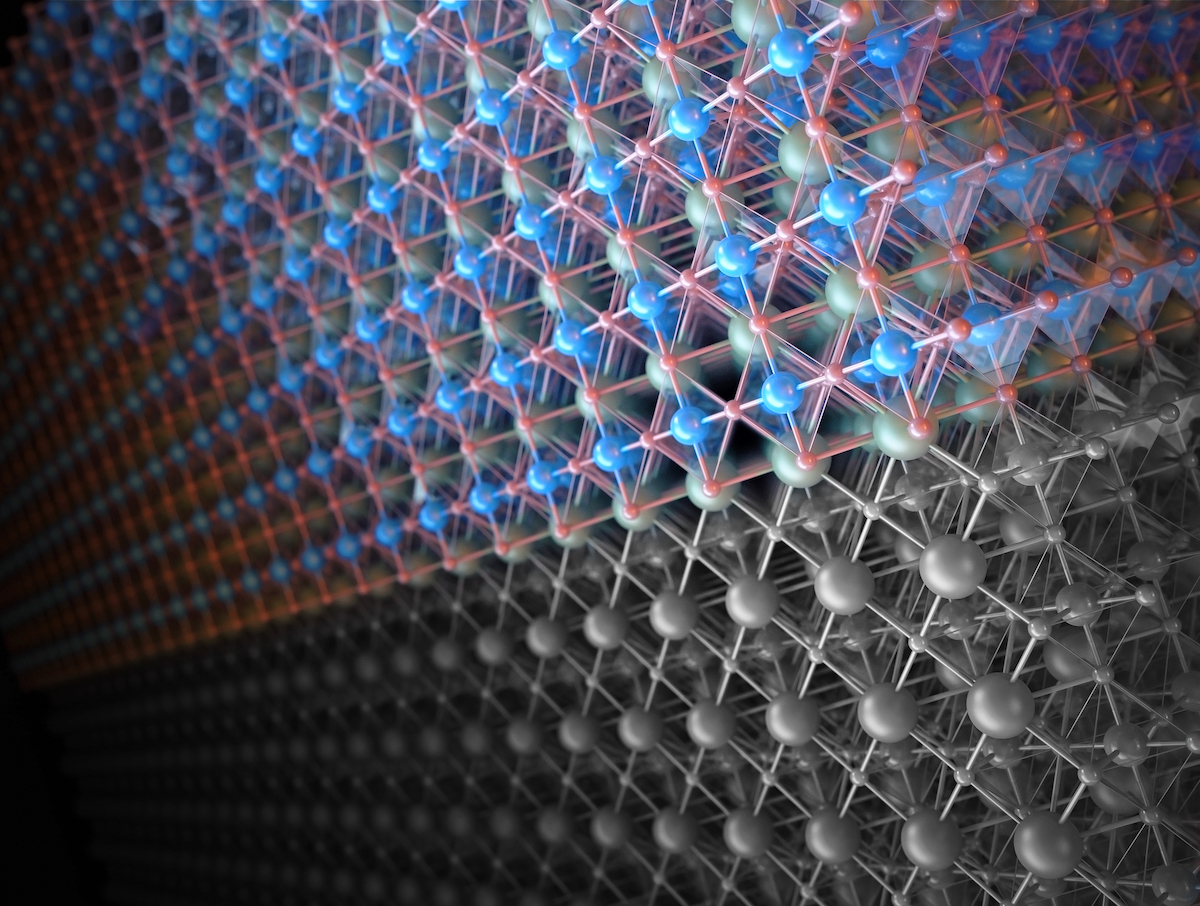
Lithium-ion batteries power everything from smart phones to electric cars, but especially when it comes to lowering the cost and extending the range of all-electric vehicles, they need to store a lot more energy. The critical component for energy storage is the anode, and Berkeley Lab scientists have developed a new anode material that can absorb eight times the lithium and has far greater energy capacity than today’s designs.

MORE>

Anti-Helium Discovered in the Heart of STAR

April 24, 2011

Antimatter nuclei of helium-4, the heaviest antiparticles ever found, have been created by the STAR experiment at Brookhaven’s Relativistic Heavy Ion Collider. Eighteen examples of the antihelium particles were detected by STAR’s Time Projection Chamber, designed and built at Berkeley Lab, in debris from a billion high-energy collisions of gold nuclei.

MORE>

Invisible Milky Way Satellite Uncovered With Help from NERSC

March 23, 2011

Astronomers predict that large spiral galaxies like our Milky Way have hundreds of satellite galaxies orbiting around them. Using supercomputers at NERSC, scientists developed a mathematical method to uncover these “dark” galaxies. When she applied it to our own Milky Way, she discovered a faint satellite might be lurking on the opposite side of the galaxy from Earth.

MORE>

A Superbright Supernova That’s the First of Its Kind

December 2, 2009

A superbright supernova found in a dwarf galaxy by the Nearby Supernova Factory based at Berkeley Lab is the first confirmed example of a pair-instability supernova, the result of the partial core collapse and thermonuclear detonation of an enormously massive star, like the earliest stars in the Universe.

MORE>

NERSC Helps Expose Cosmic Transients

June 15, 2009

Finding rare and fleeting cosmic events not only requires the right kind of telescope and camera, it depends on high-performance computing that can pinpoint objects of interest among thousands of sky images while there’s still time for follow-up observations. Caltech and DOE’s NERSC join forces in just such a search, the Palomar Transient Factory.

MORE>

A U.S. Department of Energy National Laboratory Operated by the University of California
UC logo
Questions & CommentsPrivacy & Security Notice