LBNL Masthead A-Z Index Berkeley Lab masthead U.S. Department of Energy logo Phone Book Jobs Search
Search the News Center:
Posts Tagged ‘Nuclear Science’

Tributes to Albert Ghiorso

January 12, 2011

Albert Ghiorso, who died December 26, 2010, at the age of 95, was not only one of the world’s most extraordinary nuclear scientists, his career helped shaped Lawrence Berkeley National Laboratory during the middle decades of the 20th century. Many of those who knew him best describe his unique character and recall some of the high points and setbacks of his life and work.

MORE>

In Memorian, Albert Ghiorso, 1915-2010

January 3, 2011

Albert Ghiorso, lifelong nuclear scientist at Lawrence Berkeley National Laboratory, the co-discoverer of twelve chemical elements, more than anyone else in history, died December 26, 2010, at the age of 95.

MORE>

Into the Ice: Completing the IceCube Neutrino Observatory

December 17, 2010

IceCube, the world’s most sensitive neutrino detector, is now complete. The giant neutrino telescope, buried a mile and a half deep in the Antarctic ice, now has its complete array of 86 strings carrying over 5,000 photodetectors, deployed to search for signs of neutrinos passing through the clear polar ice. The electronics and packaging of the photodetectors, called Digital Optical Modules, were conceived, designed, and tested by Berkeley Lab scientists and engineers.

MORE>

A Flow of Heavy-Ion Results from the LHC

December 8, 2010

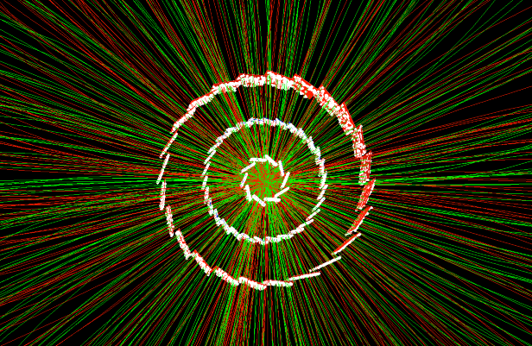
CERN’s Large Hadron Collider collides protons most of the year but switches to massive lead nuclei for a month. Collisions of these heavy ions reproduce the quark-gluon plasma that filled the universe millionths of a second after the big bang. Much of the program for quark-gluon plasma studies is shaped by theoretical and experimental contributions from Berkeley Lab’s Nuclear Science Division, as shown by results from ALICE and other experiments during the LHC’s first lead-lead run just concluded.

MORE>

GRETINA Moves Into Its Cave

November 12, 2010

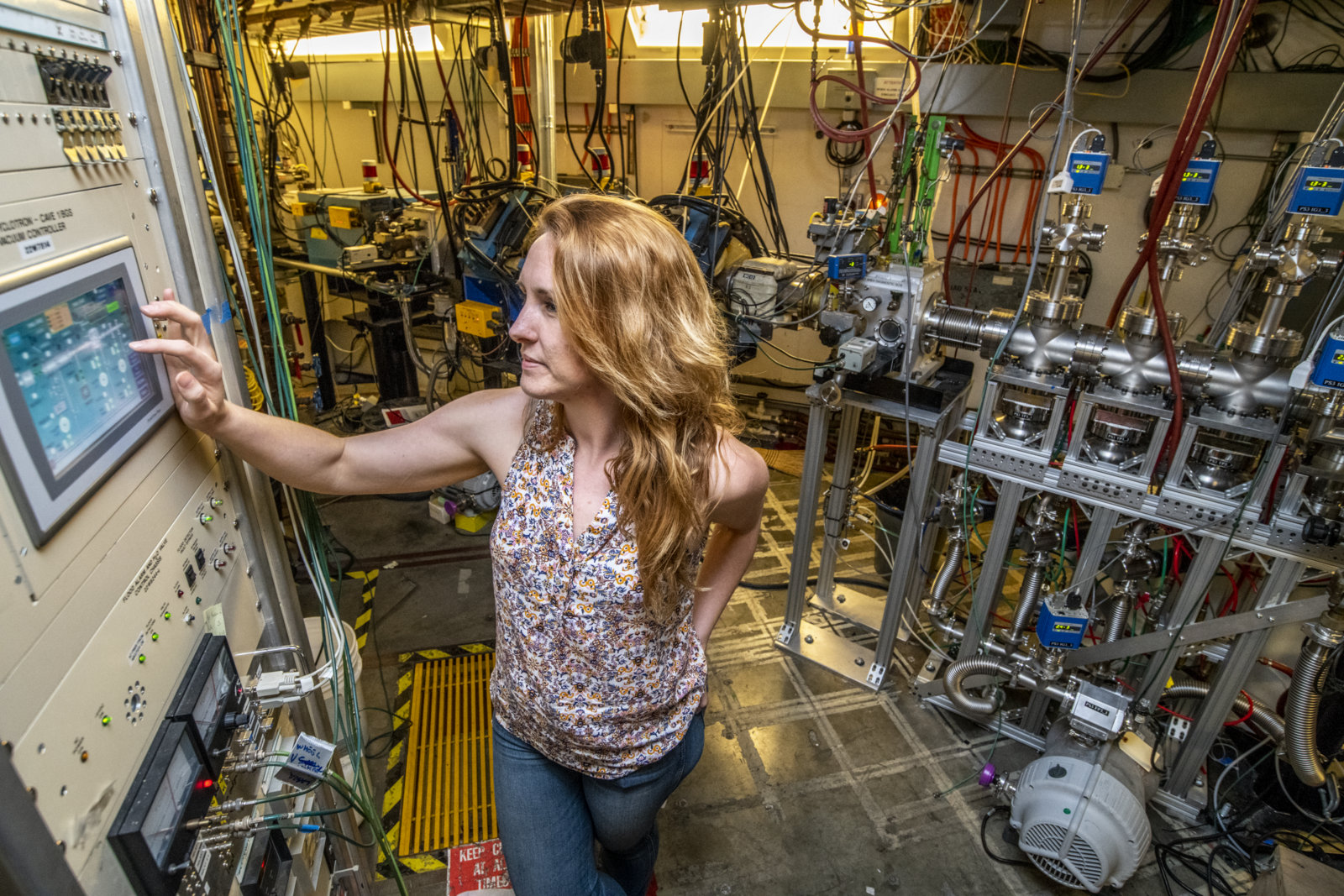
GRETINA is the most sensitive gamma-ray detector ever built for studies of the nucleus, including how the natural elements were formed in stars and supernovae, as well as the properties of artificial superheavy elements. GRETINA, now being assembled at Berkeley Lab’s 88-Inch Cyclotron, is the first stage of the even more powerful GRETA, the Gamma-Ray Energy Tracking Array.

MORE>

Large Hadron Collider Pauses Protons; Looks Ahead to Lead

November 4, 2010

The Large Hadron Collider has completed many successful months of colliding protons (hydrogen ions) at record-breaking energies and now begins four weeks of colliding much more massive lead ions, giving access to different physical phenomena. Berkeley Lab hosts U.S. participation in the ALICE experiment, designed specifically to study the heavy-ion collisions that give rise to a unique phase of matter, the quark-gluon plasma. Berkeley Lab is also a major participant in the ATLAS experiment, one of the other LHC experiments that will study lead-lead collisions.

MORE>

Six New Isotopes of the Superheavy Elements Discovered

October 26, 2010

A team of researchers has used Berkeley Lab’s 88-Inch Cyclotron to create six new isotopes of the superheavy elements, reaching in an unbroken chain of decays from element 114 down to rutherfordium. The discovery is a major step toward understanding how to explore the long-sought Island of Stability, which is thought to lie in the vicinity of element 114 – and possibly beyond.

MORE>

Putting a spin on light and atoms

September 14, 2010

Some of the most sensitive devices for detecting magnetic fields use light to put a spin on atoms and then measure the spin orientation. Now a team from Berkeley Lab, UC Berkeley, and the Vavilov State Optical Institute in Russia has achieved a remarkable technical advance with this kind of magnetometer, an advance that also has potential for improving atomic clocks, quantum memory devices, and a range of other scientific gadgets that depend on measuring spinning atoms with light.

MORE>

Testing the Best-Yet Theory of Nature

June 24, 2010

With a confidence level of 100 billion to one, the most sensitive test yet shows that the spin-statistics theorem, one of the pillars of modern physics, really works: bosons and fermions are different.

MORE>

Wriggling Neutrinos Caught in the Act

June 3, 2010

The first direct observation of a muon neutrino turning into a tau neutrino at the Gran Sasso underground laboratory in Italy confirms that indeed neutrinos do oscillate among “flavors.” Berkeley Lab’s Kevin Lesko says the result “really nails the neutrino oscillation phenomenon.”

MORE>

A U.S. Department of Energy National Laboratory Operated by the University of California
UC logo
Questions & CommentsPrivacy & Security Notice