

An advanced medical imaging technology from the U.S. Department of Energy’s (DOE) Lawrence Berkeley National Laboratory (Berkeley Lab) has been honored with a 2026 R&D 100 Award. The award, presented by R&D Magazine and selected by an independent panel of judges, recognizes the year’s 100 most innovative and disruptive technology products from industry, academia, and government-sponsored research.
The R&D 100 winning technology, Time of Flight Cascade Gamma Ray Imaging, generates images of very low concentrations of radionuclides emitting cascade gamma-rays, extending the capabilities of nuclear medicine scanners to enable advanced therapies such as alpha-targeted therapies for cancer.
Also recognized with an R&D 100 award was Pele, an open-source fuel combustion simulation suite led by the National Lab of the Rockies and co-developed by several other national labs including Berkeley Lab.
The winning teams will be celebrated at the R&D 100 gala banquet in Phoenix, Arizona, on November 19.
These are the technologies and their Berkeley Lab contributors:
Revolutionizing cancer therapy with advanced imaging
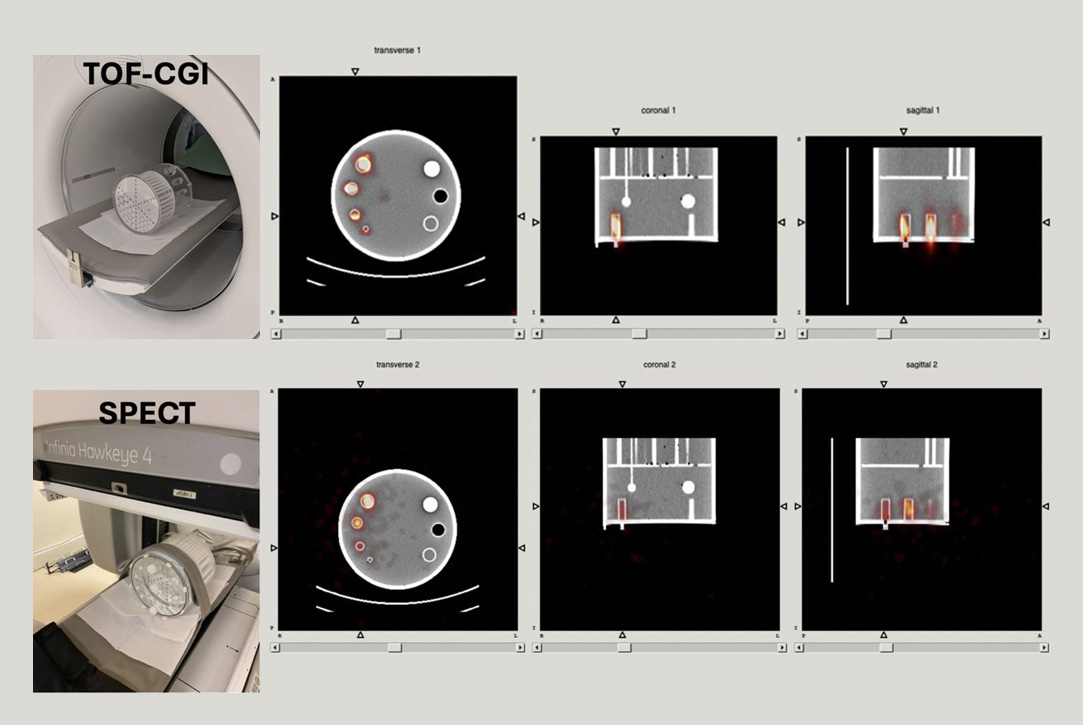
Side-by-side comparison of TOF-CGI image in a SIEMENS Vision scanner vs a SPECT image in a GE Hawkeye 4. The TOF-CGI images show much lower noise, which is reflected in superior SNR with respect to SPECT. (Credit: Applied Nuclear Physics)
Time of Flight Cascade Gamma Ray Imaging (TOF-CGI) highlights a major step forward in medical diagnostics. TOF-CGI generates high-sensitivity images of very low concentrations of radionuclide emissions, significantly extending the capabilities of positron emission tomography (PET) scanners. This new technology paves the way for advanced therapies, particularly alpha-targeted cancer treatments, by allowing clinicians to visualize the distribution of therapeutic radionuclides with unprecedented precision. TOF-CGI offers superior sensitivity compared to existing PET and SPECT technologies, making it crucial for optimizing patient outcomes.
The development team is led by Javier Caravaca Rodriguez.
The Pele simulation suite for modeling fuel combustion, led by the National Lab of the Rockies and co-developed by Berkeley Lab researchers, also won an R&D 100 Award. Predicting exactly how fuel burns in heavy-duty engines, gas turbines, and rocket motors is essential to optimizing performance and preventing equipment damage, but running physical experiments in these extreme environments is notoriously difficult and prohibitively expensive. Harnessing exascale supercomputing and artificial intelligence and built on the Lab’s AMReX framework, Pele accurately models complex combustion for both low-speed and high-speed fuel-air interactions and enables scientists to accelerate the design of next-generation aerospace and power technologies.
The development team, led by Marcus Day (NLR), includes Ann Almgren, John Bell, Andrew Myers, Andrew Nonaka, and Weiqun Zhang (Berkeley Lab).
Another Berkeley Lab innovation, Reconductoring Economic and Financial Analysis Tool (REFA), which helps transmission planners better understand the financial, environmental, and economic benefits of reconductoring upgrades, was also selected as a finalist for the R&D 100 Awards.
For information about licensing the above technologies, contact [email protected].
###
Lawrence Berkeley National Laboratory (Berkeley Lab) is committed to groundbreaking research focused on discovery science and solutions for abundant and reliable energy supplies. The lab’s expertise spans materials, chemistry, physics, biology, earth and environmental science, mathematics, and computing. Researchers from around the world rely on the lab’s world-class scientific facilities for their own pioneering research. Founded in 1931 on the belief that the biggest problems are best addressed by teams, Berkeley Lab and its scientists have been recognized with 17 Nobel Prizes. Berkeley Lab is a multiprogram national laboratory managed by the University of California for the U.S. Department of Energy’s Office of Science.
DOE’s Office of Science is the single largest supporter of basic research in the physical sciences in the United States, and is working to address some of the most pressing challenges of our time. For more information, please visit energy.gov/science.

The National Academy of Sciences Elects Two Berkeley Lab Researchers

Three Berkeley Lab Researchers Named AAAS Fellows