
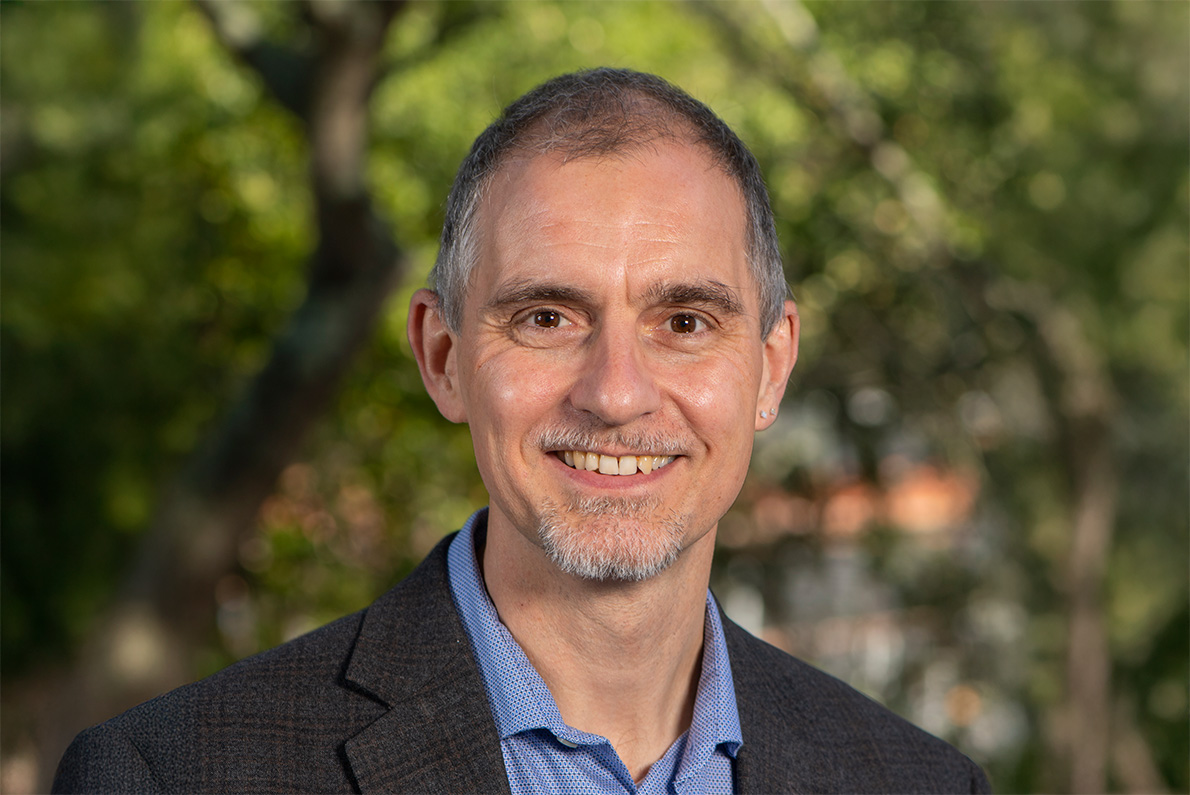
Reiner Kruecken, an internationally recognized nuclear physicist, has been named the Associate Laboratory Director (ALD) for the Physical Sciences Area of Lawrence Berkeley National Laboratory (Berkeley Lab). His appointment was approved by the University of California and is effective July 1.
The Physical Sciences Area, which is home to four divisions — Accelerator Technology and Applied Physics, Engineering, Nuclear Science, and Physics — seeks to understand the fundamental physics of the universe at scales ranging from the infinitely small, inside the world of subatomic particles and nuclei, to the infinitely large, including the structure and evolution of the universe. The group also develops and produces engineered devices such as detectors and magnets for some of the world’s most advanced nuclear experimental facilities, telescopes, and particle detectors. Kruecken succeeds Natalie Roe, who has served as ALD since 2020.
“The Physical Sciences Area has a distinguished legacy of achievements in science and engineering. Reiner’s extensive research background and ability to lead large teams and projects will ensure this tradition will continue in the years ahead,” said Berkeley Lab Director Mike Witherell.
Kruecken joined Berkeley Lab in 2022 to serve as Division Director of the Nuclear Science Division. Before joining Berkeley Lab, he served as Deputy Director and Chief Research Officer at TRIUMF, Canada’s particle accelerator center, where he helped shape TRIUMF’s strategic vision and co-led the Advanced Rare Isotope Laboratory (ARIEL) project. His research spans the structure and dynamics of atomic nuclei, nuclear astrophysics, neutrinoless double-beta decay, heavy-ion collisions, and applied nuclear science.
Under his leadership, the Nuclear Science Division advanced key initiatives, among them the GRETA and CUPID detectors, the heavy-element and nuclear data programs, as well as developments of the Electron Ion Collider Silicon Vertex Tracker and radiation imaging applications.
Kruecken received his doctorate in nuclear physics from the University of Cologne, Germany in 1995, working on gamma-ray spectroscopy. He is a fellow of the American Association for the Advancement of Science and a fellow of the American Physical Society. Over the course of his career, he has held faculty positions at the University of British Columbia, the Technical University of Munich, and Yale University, and played leadership roles in major international collaborations and advisory bodies in Europe, North America, and Asia.
###
Lawrence Berkeley National Laboratory (Berkeley Lab) is committed to groundbreaking research focused on discovery science and solutions for abundant and reliable energy supplies. The lab’s expertise spans materials, chemistry, physics, biology, earth and environmental science, mathematics, and computing. Researchers from around the world rely on the lab’s world-class scientific facilities for their own pioneering research. Founded in 1931 on the belief that the biggest problems are best addressed by teams, Berkeley Lab and its scientists have been recognized with 17 Nobel Prizes. Berkeley Lab is a multiprogram national laboratory managed by the University of California for the U.S. Department of Energy’s Office of Science.
DOE’s Office of Science is the single largest supporter of basic research in the physical sciences in the United States, and is working to address some of the most pressing challenges of our time. For more information, please visit energy.gov/science.