All News

3 Knowns and 3 Unknowns about Dark Matter

Image - A composite image of the "bullet cluster," a galaxy cluster formed by a collision of two clusters. The pink clumps show hot gas containing most of the normal matter, while the two blue clumps reveal where most of the mass in the clusters is actually contained. This provides evidence for dark matter since most of the mass was expected to be concentrated around the pink areas. (Credit: X-ray image by NASA/CXC/M.Markevitch et al.; optical image by NASA/STScI, Magellan/U.Arizona/D.Clowe et al.; lensing map image by NASA/STScI, ESO WFI, Magellan/U.Arizona/D.Clowe et al.)

Water-Energy Nexus New Focus of Berkeley Lab Research

New workflow to help microbe-based biofuels production

Got Plaque? Berkeley Lab Tech Provides Measure of Artery Health

New Berkeley Lab Study Tallies Environmental and Public Health Benefits of Solar Power

Calling All Innovators: Submit Your Ideas for Smart, Energy Efficient Buildings!

Berkeley Lab Participates in New National Microbiome Initiative

$40M to Establish New Observatory Probing Early Universe

Photo - The Simons Array will be located in Chile's High Atacama Desert, at an elevation of about 17,000 feet. The site currently hosts the Atacama Cosmology Telescope (bowl-shaped structure at upper right) and the Simons Array (the three telescopes at the bottom left, middle and right). The Simons Observatory will incorporate several new telescopes and set the stage for a next-generation experiment. (University of Pennsylvania)

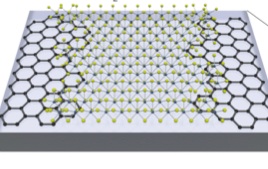
Berkeley Lab Scientists Discover Surprising New Properties in a 2-D Semiconductor

Scientists Image First Steps in DNA Transcription

Scientists Take a Major Leap Toward a ‘Perfect’ Quantum Metamaterial

Illustration - The wavelike pattern at the top shows the accordion-like structure of a proposed quantum material—an artificial crystal made of light—that can trap atoms in regularly spaced nanoscale pockets. These pockets can be made to hold a large collection of ultracold “host” atoms (green), slowed to a standstill by laser light, and individually planted “probe” atoms (red) that can be made to transmit quantum information in the form of a photon (particle of light). The lower panel shows how the artificial crystal can be reconfigured with light from an open (hyperbolic) geometry to a closed (elliptical) geometry, which greatly affects the speed at which the probe atom can release a photon. (Credit: Pankaj K. Jha/UC Berkeley)

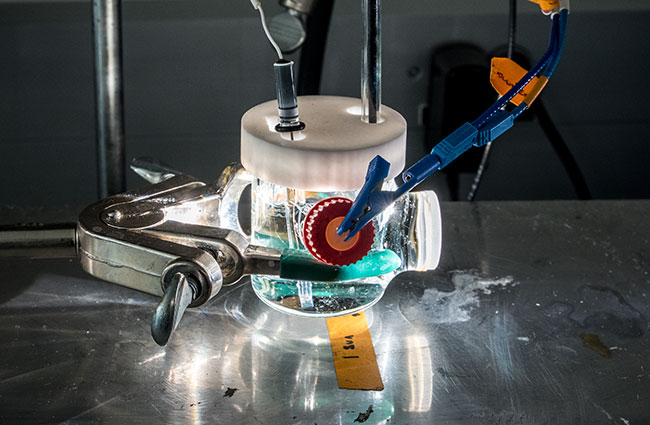
Berkeley Lab Scientists Brew Jet Fuel in One-Pot Recipe