All News

Scientists Bring Polymers Into Atomic-Scale Focus

Image - This image shows a rendering (gray and pink) of the molecular structure of a peptoid polymer that was studied by a team led by Berkeley Lab and UC Berkeley. The team’s success in imaging the atomic-scale structure of polymers could inform new designs for plastics, like those in the water bottles shown in the background. (Credit: Berkeley Lab, Charles Rondeau/PublicDomainPictures.net)

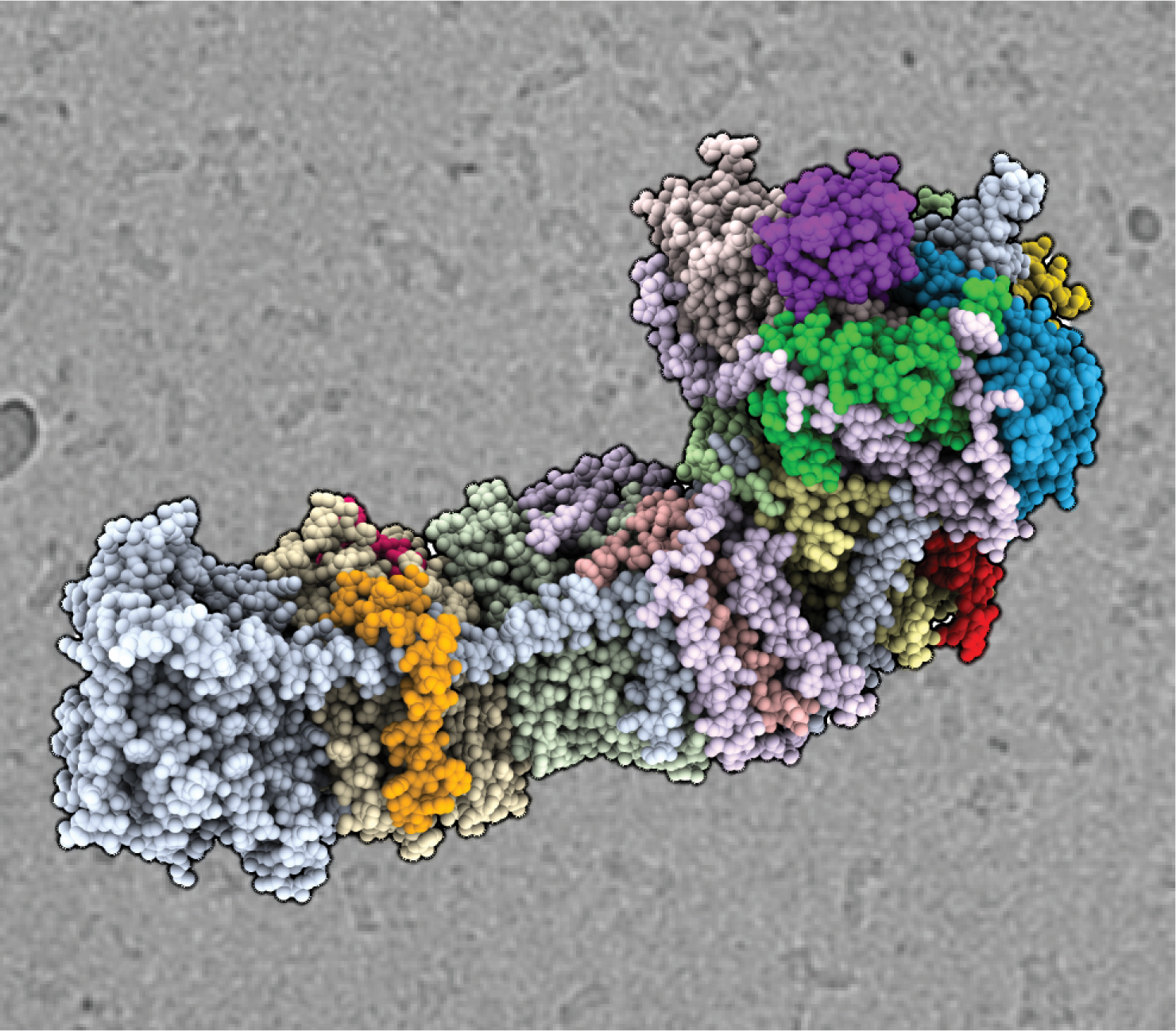
Scientists Capture Photosynthesis in Unprecedented Detail

A Next Step for GRETA: A Better Gamma-Ray Detector

Image - A rendering of the completed Gamma-Ray Energy Tracking Array, known as GRETA. (Credit: Berkeley Lab)

Award Finalists Demonstrate Improved Nuclear Physics Code for Supercomputing

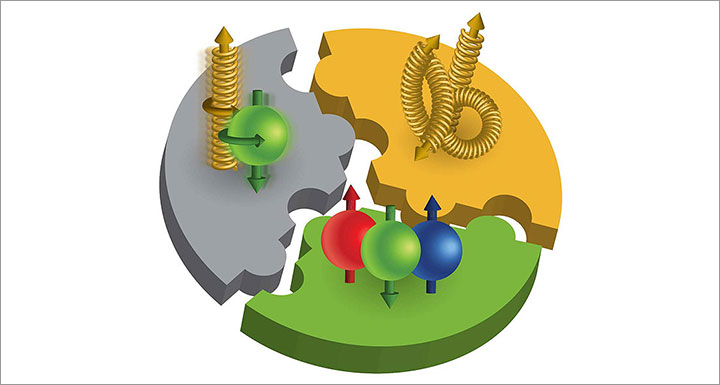
Photo - From left: David Brantley, André Walker-Loud, Pavlos Vranas, Henry Monge-Camacho, Thorsten Kurth, and Chia Cheng “Jason” Chang – pictured here at Berkeley Lab – participated in an international team that calculated the nucleon axial coupling, a property important to understanding the neutron lifetime. (Credit: Marilyn Chung/Berkeley Lab)

Photosynthesis Like a Moss

Berkeley Lab Joins Other Labs and Universities in LaserNetUS, A New Nationwide High-Intensity Laser Network

Image - BELLA, the Berkeley Laboratory Laser Accelerator. (Credit: Roy Kaltschmidt/Berkeley Lab)

DOE to Build Next-Generation Supercomputer at Lawrence Berkeley National Laboratory

Photo - Saul Perlmutter

A Solar Cell That Does Double Duty for Renewable Energy

The HPEV cell's extra back outlet would allow the current to be split into two, so that one part of the current contributes to solar fuels generation, and the rest can be extracted as electrical power.

Improving Climate Models to Account for Plant Behavior Yields ‘Goodish’ News

Machine Learning to Help Optimize Traffic and Reduce Pollution

Expert Q&A: Safeguarding the Nation’s Energy Infrastructure

Landscape of electricity pylon and wind turbines

VIDEO: 5,000 Robots Merge to Map the Universe in 3D

Image - This three-minute video describes the focal plane, a key component for the Dark Energy Spectroscopic Instrument. The focal plane will be equipped with 5,000 swiveling robots that are designed to point at pre-selected galaxies and gather their light. The measurements will be used to build the largest 3D map of the universe. (Credit: Marilyn Chung/Berkeley Lab)