
All News

Solving the Dark Energy Mystery: A New Assignment for a 45-Year-Old Telescope
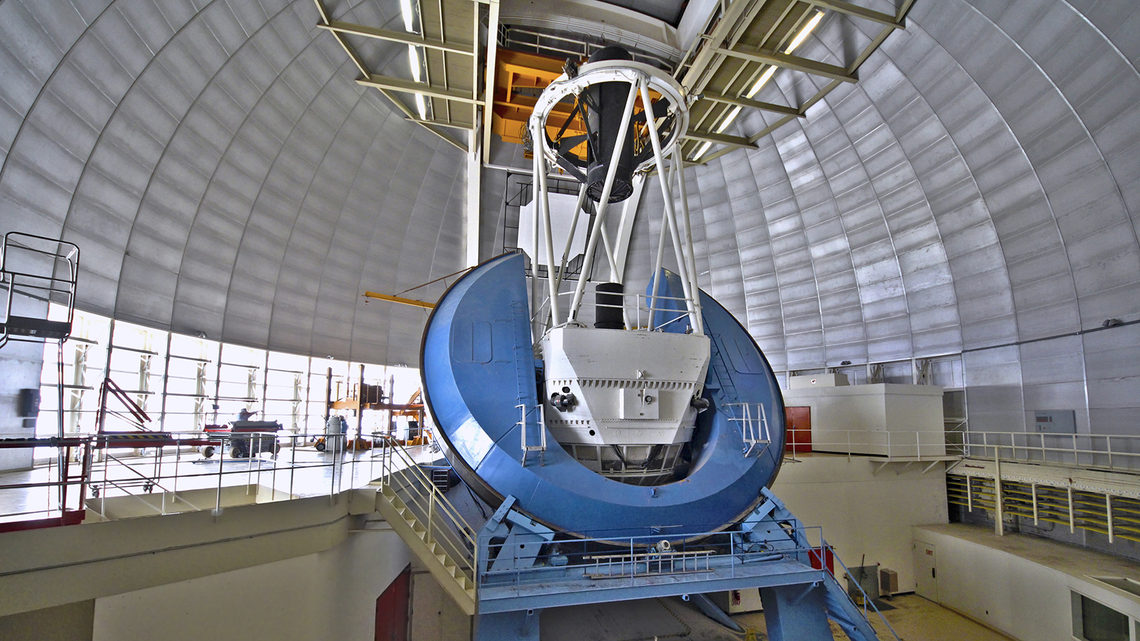
Photo - A view inside the dome at the Mayall Telescope in Arizona. The telescope’s 2-meter corrector barrel will be removed and replaced with a new corrector barrel for the Dark Energy Spectroscopic Instrument. DESI’s installation will begin soon at the telescope. (Credit: P. Marenfeld and NOAO/AURA/NSF)

Scientists Discover ‘Chiral Phonons’ – Atomic Rotations in a 2-D Semiconductor Crystal
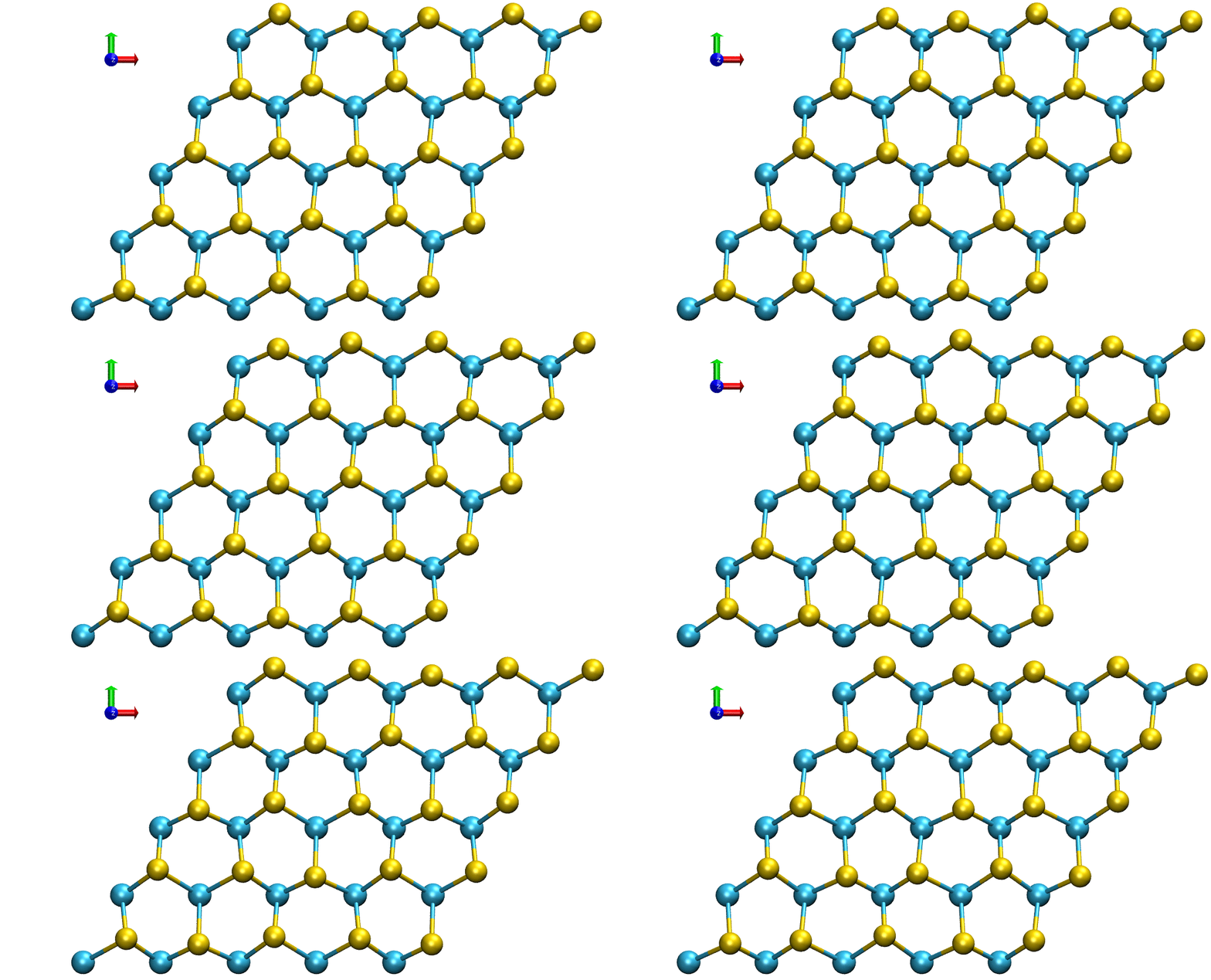
Animation - The atomic motion in a 2-D material, tungsten disulfide, is shown in this animation. In this phonon mode (known as longitudinal or LO), the selenium atoms (yellow) rotate clockwise while the tungsten atoms (blue) are still. (Credit: Hanyu Zhu, et al.)

Gene Enhancers Are Important Despite Apparent Redundancy
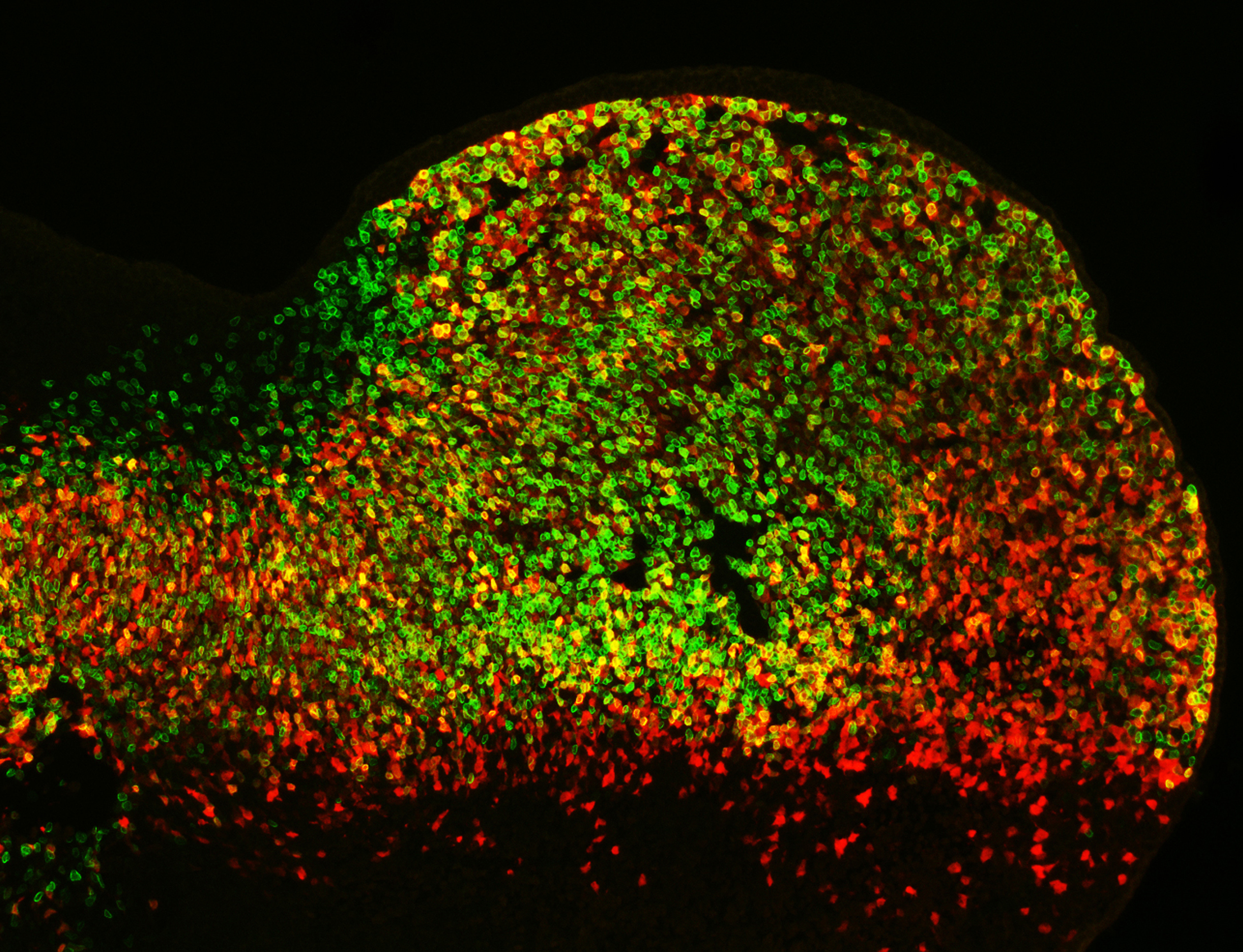
Cell activity patterns of two gene enhancers (red and green cells). Cells in which both enhancers are active appear yellow. (Credit: Marco Osterwalder).

Berkeley Lab Researchers Contribute to Making Blockchains Even More Robust
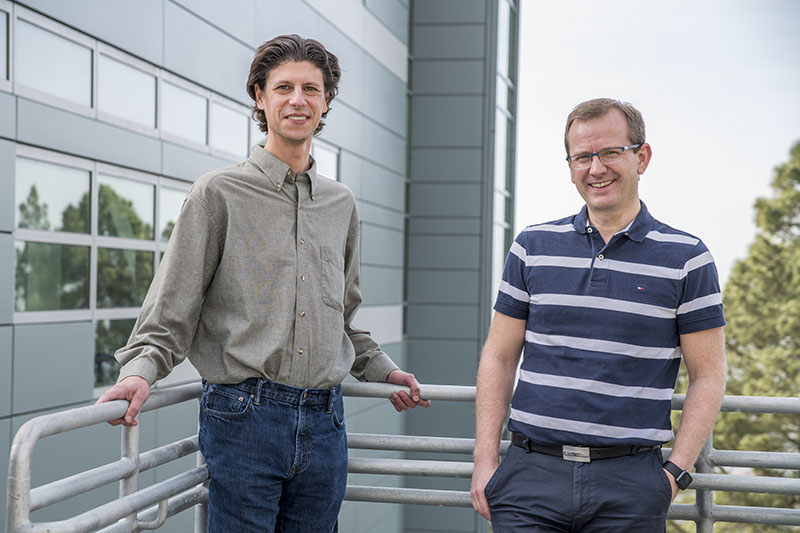
Sean Peisert (left) and Hein Meling (right) at Lawrence Berkeley National Laboratory

Applying Machine Learning to the Universe’s Mysteries
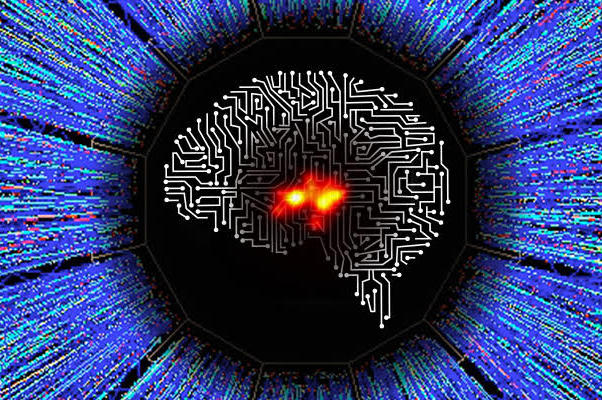
Image - The colored lines represent calculated particle tracks from particle collisions occurring within Brookhaven National Laboratory’s STAR detector at the Relativistic Heavy Ion Collider, and an illustration of a digital brain. The yellow-red glow at center shows a hydrodynamic simulation of quark-gluon plasma created in particle collisions. (Credit: Berkeley Lab)

Silencing Is Golden: Scientists Image Molecules Vital for Gene Regulation
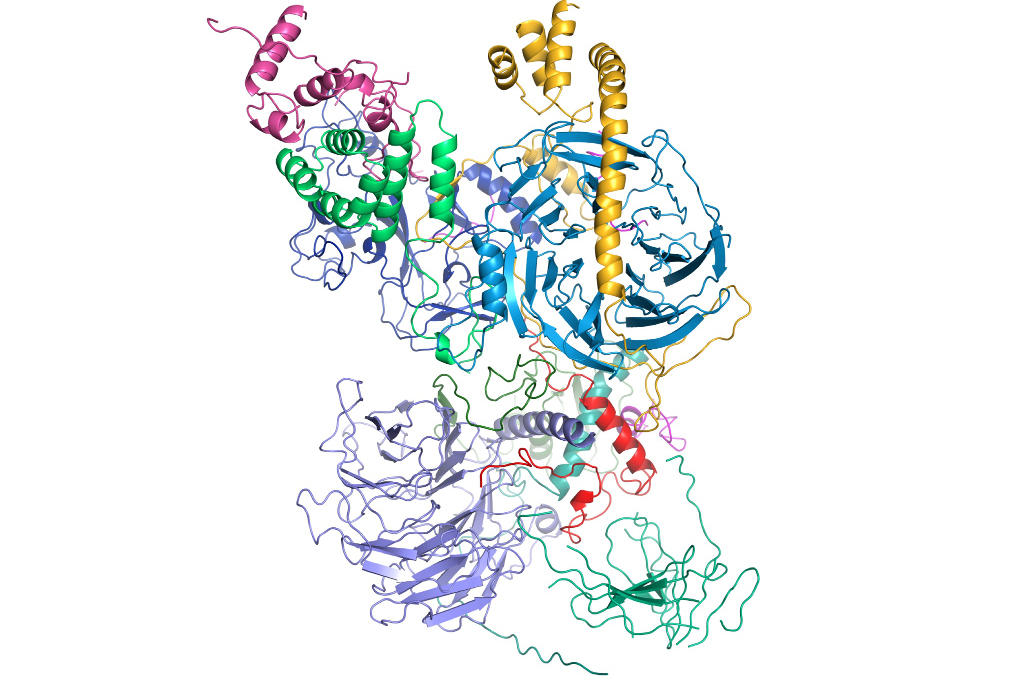
Image - Structure of the human Polycomb Repressive Complex 2 (PRC2) bound to cofactors obtained by cryo-electron microscopy. Both cofactors mimic the histone protein tail to stabilize and stimulate the enzymatic activity of PRC2. (Credit: Vignesh Kasinath)

X-Ray Experiments Suggest High Tunability of 2-D Material
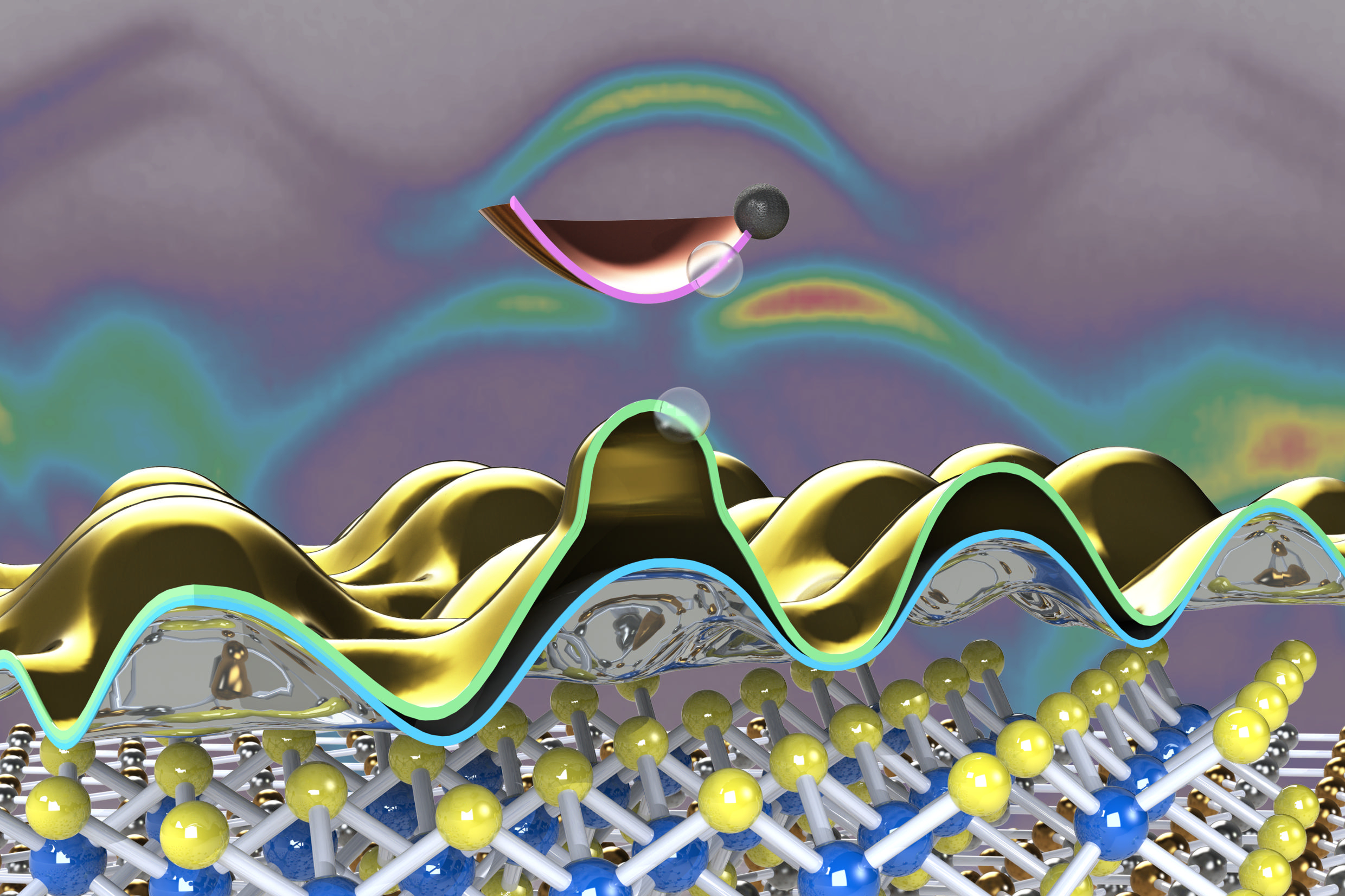
Image - This rendering shows the atomic structure of a 2-D material ("ball-and-stick" representation at bottom) and the signature (middle and top) of electronic properties that were observed using an X-ray technique at Berkeley Lab’s MAESTRO beamline. (Credit: Søren Ulstrup/Aarhus University, et al.)

New Discovery Could Improve Organic Solar Cell Performance
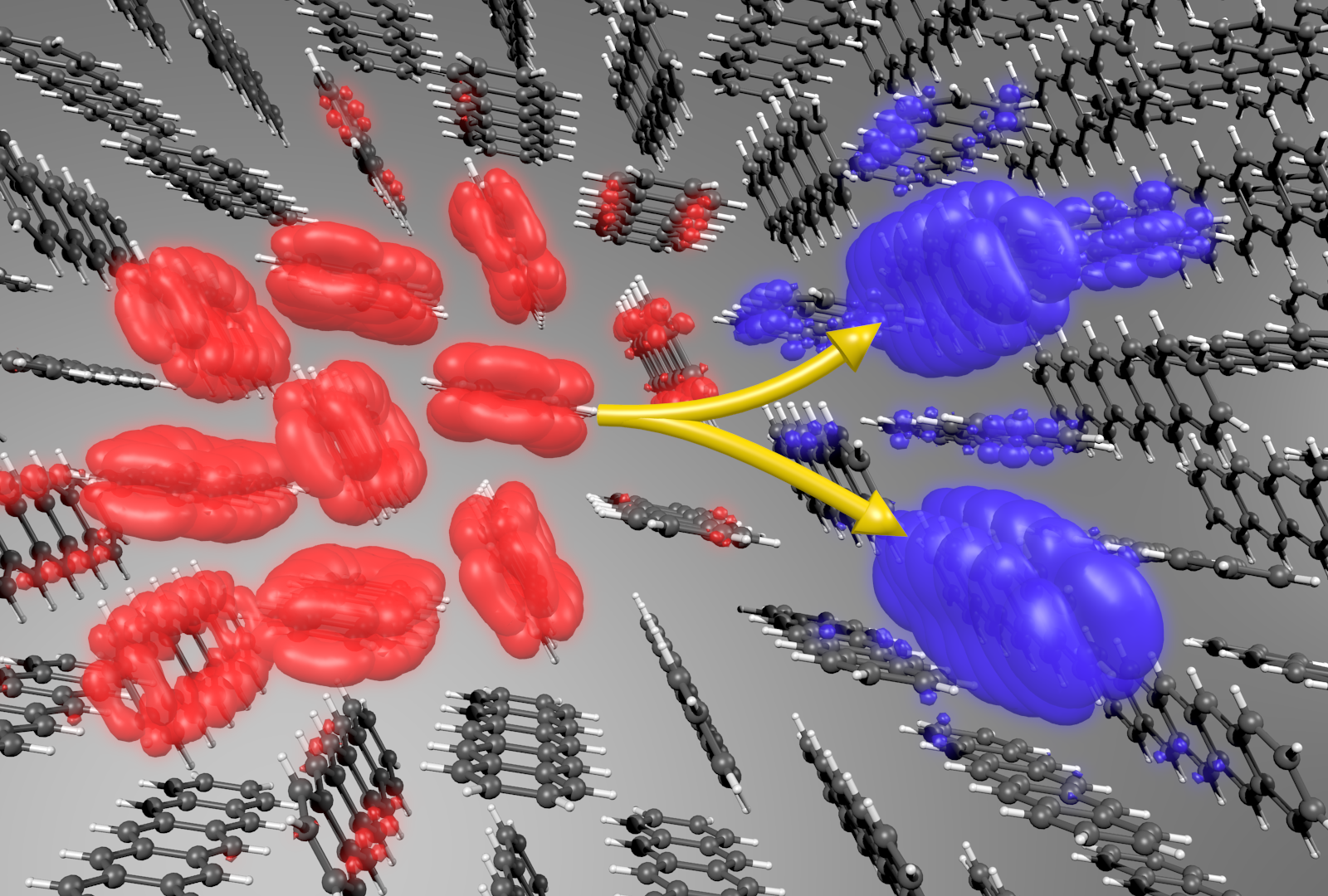
Image - In this image, an optically excited spin-singlet state (red), which features electron-hole pairs, splits into a pair of spin-triplet states (blue). The individual triplets have equal and opposite center-of-mass momenta – they behave like waves moving in opposite directions along a crystal. The gray and white spheres represent carbon and hydrogen atoms, respectively. (Credit: Florian Brown-Altvater/Berkeley Lab)

It All Starts With a ‘Spark’: Berkeley Lab Delivers Injector That Will Drive X-Ray Laser Upgrade
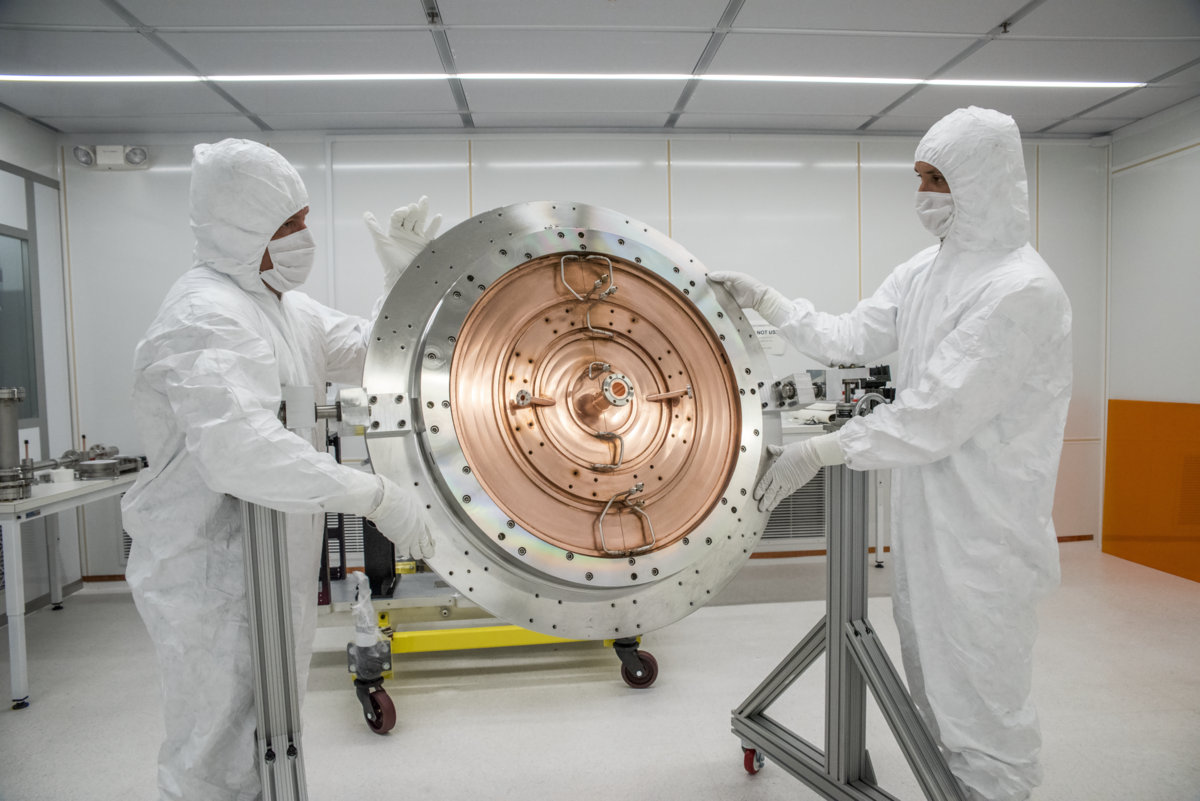
Photo - Berkeley Lab Mechanical Engineers Joe Wallig, left, and Brian Reynolds work on the final assembly of the LCLS-II injector gun in a specially designed clean room at Berkeley Lab in August. (Credit: Marilyn Chung/Berkeley Lab)

Scientists Discover Material Ideal for Smart Photovoltaic Windows

Coupling Experiments to Theory to Build a Better Battery
X-Rays Reveal ‘Handedness’ in Swirling Electric Vortices

Image - Just as people can be left-handed or right-handed, scientists have observed chirality or "handedness" in swirling electric vortices in a layered material. (Credit: Pixabay)