Key Takeaways
- The DESI Legacy Imaging Surveys combined more than 263,000 telescope exposures to make the largest 2D map of the universe in visible and near-infrared light.
- Astronomers can pair the Legacy Surveys map with their own observations to explore our universe and search for rare phenomena.
- The 2D map serves as the foundation for the Dark Energy Spectroscopic Instrument survey to measure the universe in 3D and investigate dark energy.
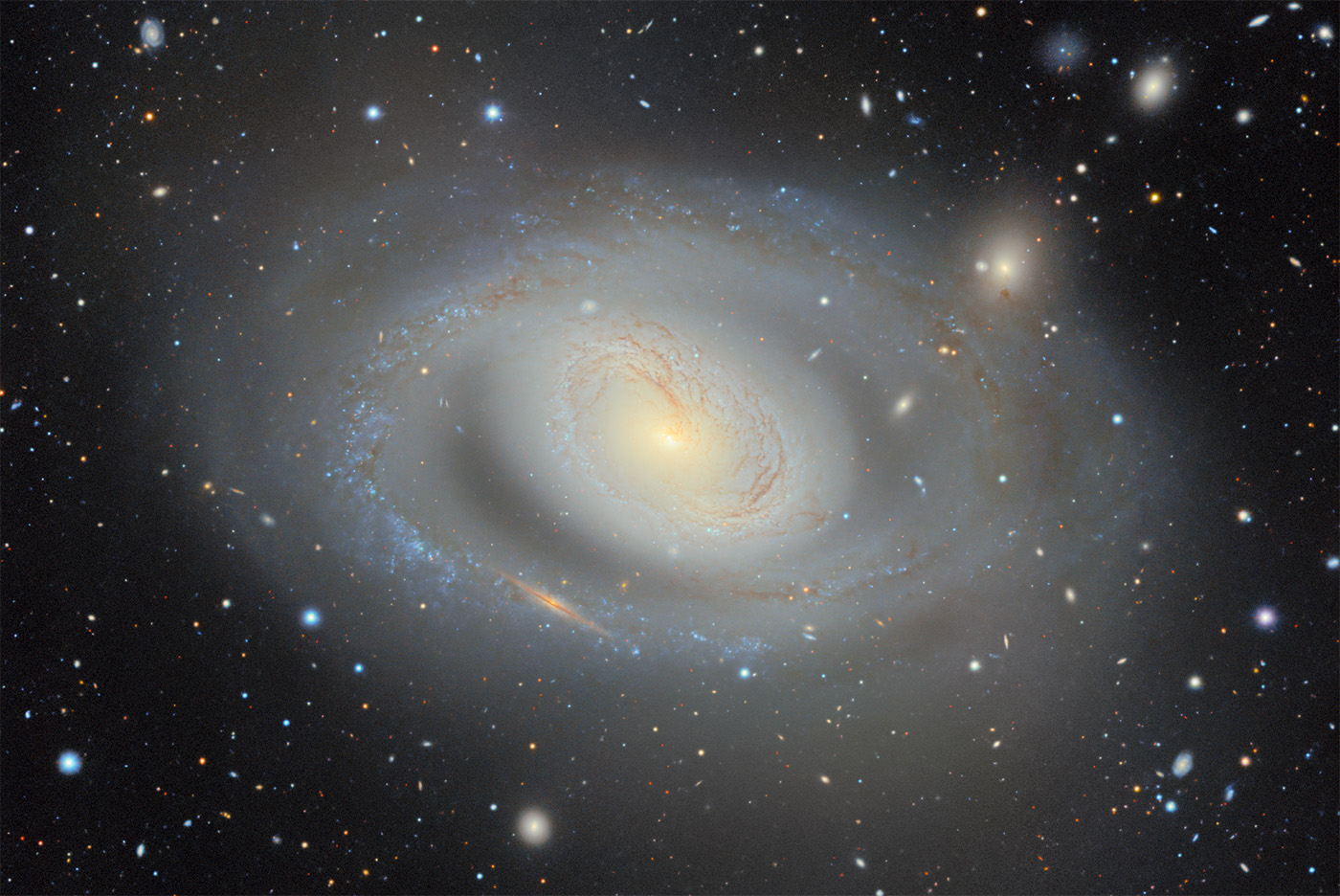
Hold on to your telescopes: the DESI Legacy Imaging Surveys team has released the largest-ever 2D color map of the universe. The 5.6-trillion-pixel map contains nearly 4 billion celestial objects, primarily stars and galaxies. The data is available for all to use and publicly viewable through the Legacy Survey Sky Viewer.
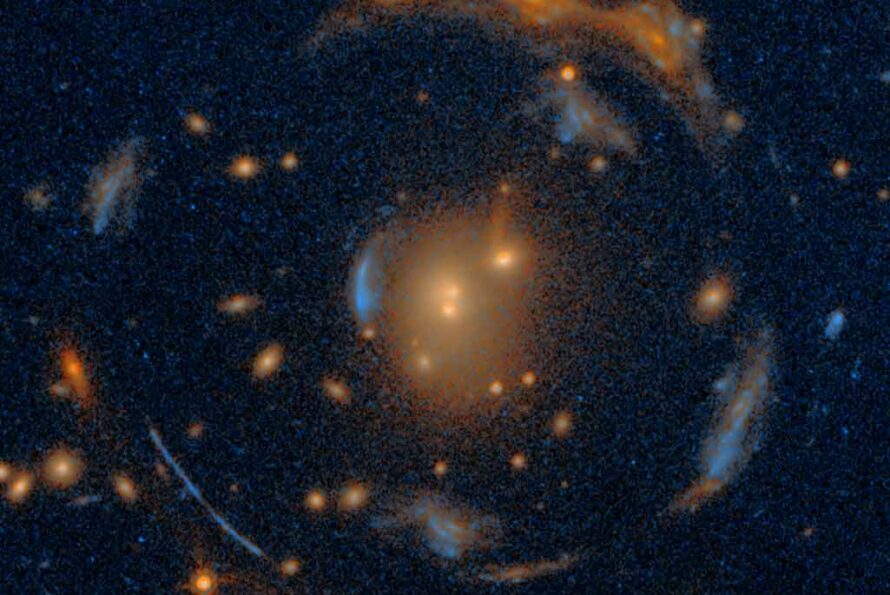
Astronomers and citizen scientists can explore the map or combine it with their own observations to better understand our universe. Researchers can search for rare phenomena like gravitational lenses, observe fleeting events like supernovae, and investigate two of physics’ biggest mysteries: dark matter, the invisible substance that accounts for most of the mass in our universe, and dark energy, the force driving our universe’s accelerating expansion.
The new map builds on earlier versions from the DESI Legacy Imaging Surveys that have already proved invaluable. To date, more than 1,800 science papers that reference the Legacy Surveys data have been published.
“It’s part of the fabric of astronomy research now,” said David Schlegel, a co-lead of the Legacy Surveys and scientist at the Department of Energy’s Lawrence Berkeley National Laboratory (Berkeley Lab). “When you’re working with astronomical objects today, you often start by pulling up the Legacy Imaging Viewer to see what you’re looking at.”
Covering roughly 75% of the sky in visible and near-infrared light, the updated map provides a deep view of the extragalactic universe not blocked by the dust and stars of our own Milky Way. Researchers expect it will remain the most comprehensive 2D map of our universe for years to come.
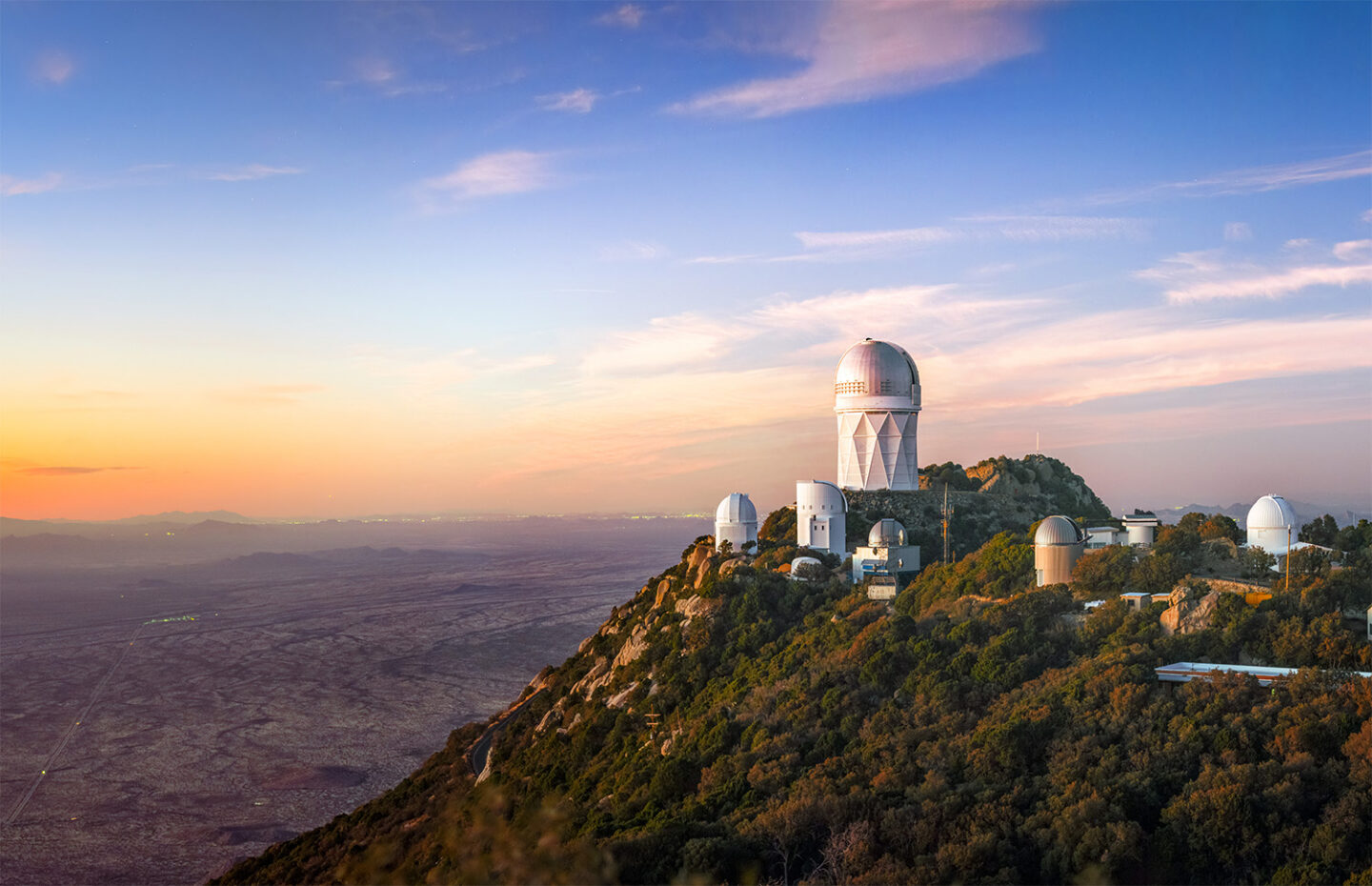
More than 160 scientists contributed to data collection for the project, and a team of 20 produced the final dataset released today. It was built by combining 263,407 telescope exposures from three ground-based sky surveys: the Dark Energy Camera Legacy Survey (DECaLS) at NSF Cerro Tololo Inter-American Observatory, the Mayall z-band Legacy Survey (MzLS) at NSF Kitt Peak National Observatory, and the Beijing-Arizona Sky Survey (BASS) at the University of Arizona’s Steward Observatory. That was supplemented by years of data from NASA’s Wide-field Infrared Survey Explorer (WISE) satellite mission and additional public data.
“For our team, these data are fundamental to our investigation of the expansion history of the universe and the formation of our galaxy,” said Arjun Dey, co-lead of the Legacy Surveys and an astronomer at NSF NOIRLab. “But the skies belong to everyone, and this survey gives everyone the chance to explore the sky and marvel at its wonders.”
Here be galaxies
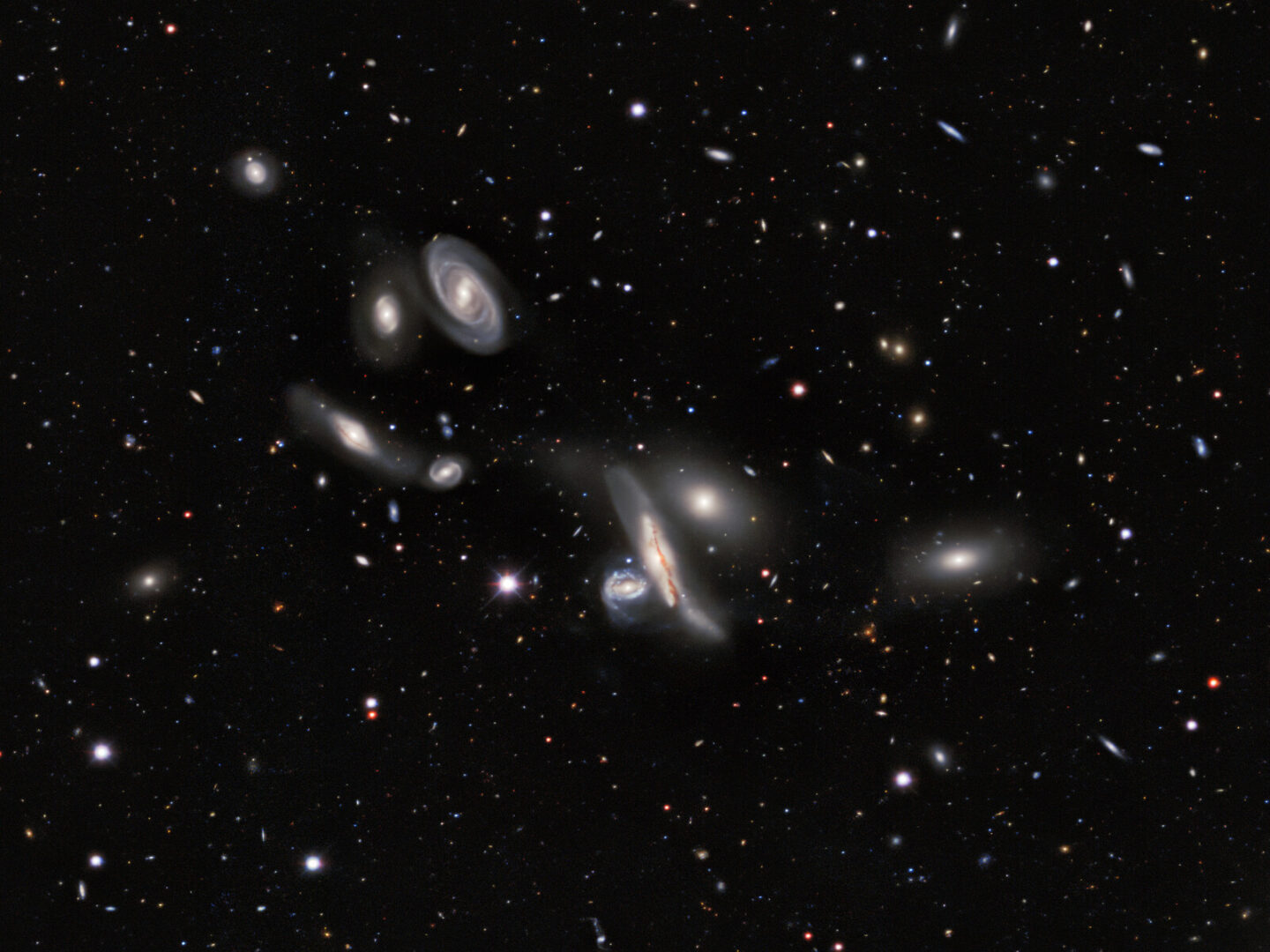
The DESI Legacy Imaging Surveys were originally conducted to prepare for the Dark Energy Spectroscopic Instrument (DESI) survey. The Legacy Surveys’ 2D map is essentially a deep photograph of the sky; it records where galaxies and stars appear and how bright they appear. This crucial step enables DESI to select objects and measure their light in different wavelengths to determine their distances, building the largest high-resolution 3D map ever made. Scientists study the way galaxies have clustered at different ages of the universe to track dark energy over time.
In April 2026, DESI completed its original five-year survey ahead of schedule and with vastly more objects than expected. The early results have shown surprising hints that dark energy’s impact may be weakening over time — a paradigm shift that could potentially shape the predicted fate of our universe. DESI expects to publish improved results using their first five years of data in 2027 and is continuing observations into 2028.
DESI was so efficient at observing galaxies, the Legacy Surveys map needed to expand. Early on, “it became clear we might run out of galaxies to look at and run out of sky, and we better start doing something about that,” said Schlegel, who also works on DESI. The new Legacy Surveys map has been used to select DESI targets since June 2026 and will guide the telescope’s operations over the coming years.
Computing the cosmos
Merging hundreds of thousands of images taken on 2,285 nights, each with unique atmospheric and telescope conditions, was a massive computational effort. It took about a year to develop the computer code and eight weeks to process all the images at the Perlmutter supercomputer at the National Energy Research Scientific Computing Center (NERSC) at Berkeley Lab.
Beyond supporting DESI, the Legacy Surveys will be a foundational reference for the next generation of telescopes. As new observatories like the NSF-DOE Vera C. Rubin Observatory (jointly funded by NSF and DOE’s Office of Science) and NASA’s Nancy Grace Roman Space Telescope come online, researchers can compare their observations with one of the deepest and most comprehensive views of the sky ever assembled.
The Legacy Surveys data will also help scientists train artificial intelligence tools to analyze petabytes of astronomical data and accelerate new discoveries. It will be among the datasets used in an astrophysics pilot project within the American Science Cloud, part of the DOE’s Genesis Mission.
The DESI Legacy Imaging Surveys are supported by the U.S. Department of Energy’s Office of High Energy Physics; the National Energy Research Scientific Computing Center, a DOE Office of Science user facility; the U.S. National Science Foundation, Division of Astronomical Sciences; and the partner institutions.
DESI is supported by the DOE Office of Science and NERSC. Additional support for DESI is provided by the NSF; the Science and Technology Facilities Council of the United Kingdom; the Gordon and Betty Moore Foundation; the Heising-Simons Foundation; the French Alternative Energies and Atomic Energy Commission (CEA); the Secretariat of Science, Humanities, Technology and Innovation (SECIHTI) of Mexico; the Ministry of Science and Innovation of Spain; and by the DESI member institutions.
###
Lawrence Berkeley National Laboratory (Berkeley Lab) is committed to groundbreaking research focused on discovery science and solutions for abundant and reliable energy supplies. The lab’s expertise spans materials, chemistry, physics, biology, earth and environmental science, mathematics, and computing. Researchers from around the world rely on the lab’s world-class scientific facilities for their own pioneering research. Founded in 1931 on the belief that the biggest problems are best addressed by teams, Berkeley Lab and its scientists have been recognized with 17 Nobel Prizes. Berkeley Lab is a multiprogram national laboratory managed by the University of California for the U.S. Department of Energy’s Office of Science.
DOE’s Office of Science is the single largest supporter of basic research in the physical sciences in the United States, and is working to address some of the most pressing challenges of our time. For more information, please visit energy.gov/science.
DESI Completes Planned 3D Map of the Universe and Continues Exploring
New DESI Results Strengthen Hints That Dark Energy May Evolve