All News

Genes, Early Environment Sculpt the Gut Microbiome

Scientists Trace ‘Poisoning’ in Chemical Reactions to the Atomic Scale

Image - A scanning electron microscopy (SEM) image showing a type of catalyst called a zeolite that is used to convert ethanol to high-value fuels. The particles measure about 15 microns in length. (Credit: PNNL)

Five Berkeley Lab Scientists Named AAAS Fellows

X-Rays Capture Unprecedented Images of Photosynthesis in Action

A New Understanding of Metastability Clears Path for Next-Generation Materials

Crop Yield Gets Boost with Modified Genes in Photosynthesis

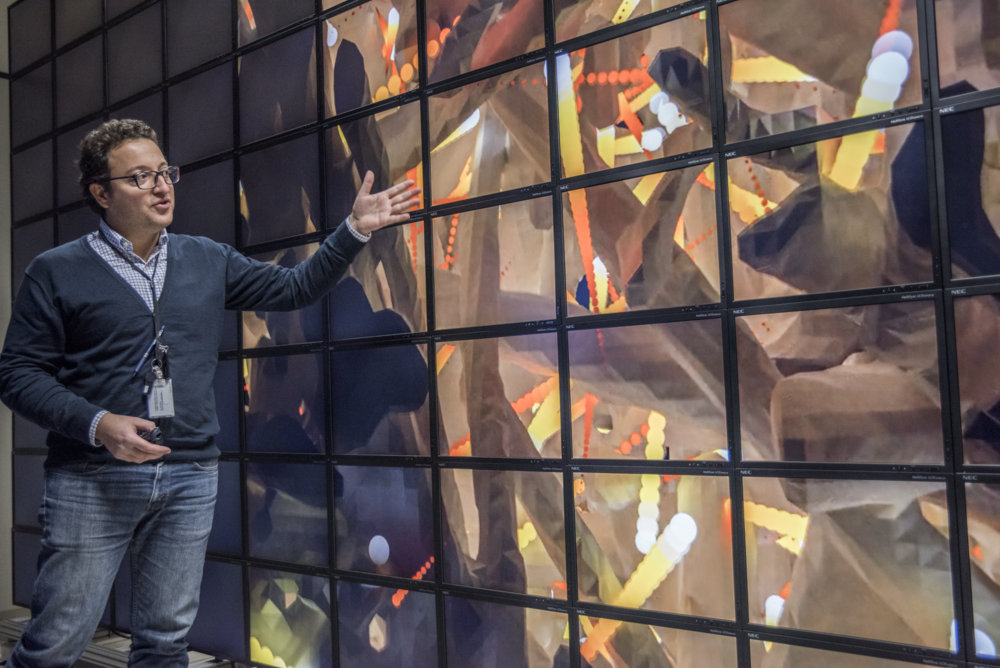
3-D Imaging Technique Maps Migration of DNA-carrying Material at the Center of Cells

Image - This image shows the skeletonized structure of heterochromatin (red represents a thin region while white represents a thick region), a tightly packed form of DNA, surrounding another form of DNA-carrying material known as euchromatin (dark blue represents a thin region and yellow represent the thickest) in a mouse’s mature nerve cell. (Credit: Berkeley Lab, UCSF)

A New Way to Image Solar Cells in 3-D

Simulations Show Swirling Rings, Whirlpool-Like Structure in Subatomic ‘Soup’

Image - This hydrodynamic simulation shows the flow patterns, or “vorticity distribution,” from a smoke ring-like swirling fluid around the beam direction of two colliding heavy ions. The simulation provides new insight about the properties of a superhot fluid known as the quark-gluon plasma. (Credit: Berkeley Lab)

Solar Cells Get Boost with Integration of Water-Splitting Catalyst onto Semiconductor

Schematic of the multi-functional water splitting catalyst layer engineered using atomic layer deposition for integration with a high-efficiency silicon cell.

Study: Carbon-Hungry Plants Impede Growth Rate of Atmospheric CO2 

Berkeley Lab Takes Home Five R&D 100 Awards for Environmental, Battery, and X-ray Technologies

Photo - The Compact Dynamic Beamstop (CDBS) device, at left, designed to provide real time information to improve X-ray crystallography experiments, with a size comparison to a ballpoint pen tip. (Credit: Berkeley Lab)