All News

VIDEO: The Making of the Largest 3D Map of the Universe

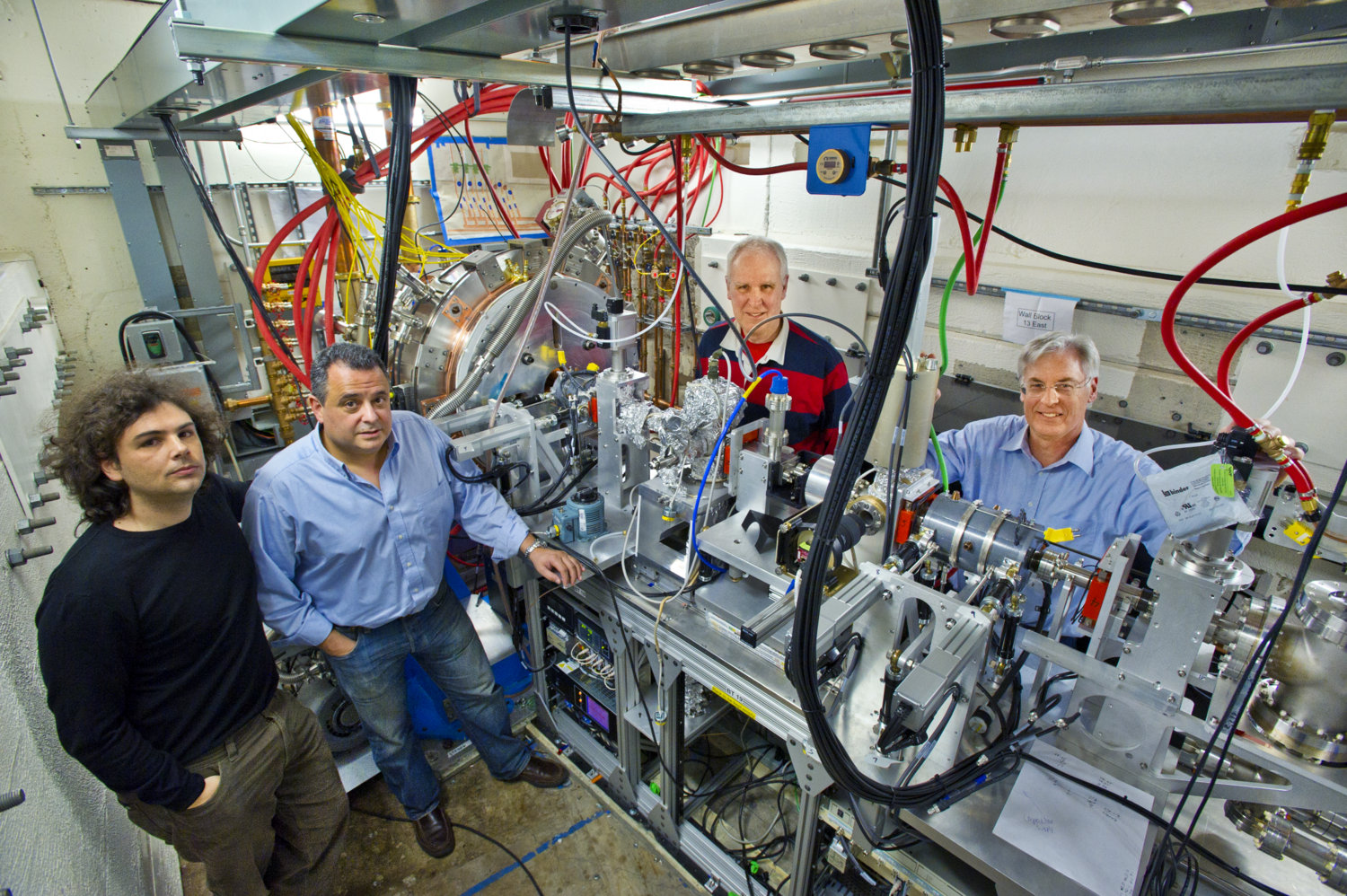
Image - In this video, DESI project participants share their insight and excitement about the project and its potential for new and unexpected discoveries. (Credit: Marilyn Chung/Berkeley Lab, DESI Collaboration)

Climate Scientists Partner with San Francisco to be Ready for Future Storms

Dark Energy Instrument’s Lenses See the Night Sky for the First Time

Berkeley Lab Team Uses Deep Learning to Help Veterans Administration Address Suicide Risks

A photo of a male doctor speaking with a veteran in a wheelchair.

Zooming in on an Inner-Cell DNA Repair Shop

Structure of human TFIIH, a large protein assembly that acts to help repair and read our genome. Shown in the foreground is the a rendering of the overall architecture, and in the background it interacts with DNA helices.

Breakthrough Study of Cell Signaling Holds Promise for Immune Research and Beyond

The atomic structure of the SOS protein, a cell messaging molecule that uses a unique timing mechanism to regulate activation of a critical immune system pathway.

Mouse Study Yields Long-Awaited Insights into Human Stomach Cancer

The Best Topological Conductor Yet: Spiraling Crystal Is the Key to Exotic Discovery

Image - This illustration shows a repeated 2D patterning of a property related to electrical conductivity, known as the surface Fermi arc, in rhodium-silicon crystal samples. (Credit: Princeton University/Berkeley Lab)

Setting a ‘Gold Standard’ for Ultrasensitive Particle Detectors

Photo - Alan “Al” Smith places an aluminum sample exposed to radiation at Berkeley Lab’s Bevatron accelerator into a lead and concrete box containing a detector at a low-level radiation counting facility in this 1950s photograph. (Credit: Berkeley Lab)

Pioneering Cancer Researcher Mina Bissell Receives Two Top Honors

Mina J. Bissell (Credit: Berkeley Lab)

Bright Skies for Plant-Based Jet Fuels

A plane flying over green trees

Sea Quark Surprise Reveals Deeper Complexity in Proton Spin Puzzle

Image - The proton spin puzzle: Scientists want to know how different constituents of the proton contribute to its spin, a fundamental property that plays a role in how these building blocks give rise to nearly all visible matter in the universe. Pieces of the puzzle include the orbital angular momentum of quarks and gluons (top left), gluon spin (top right) and quark and antiquark spin (bottom). The latest data from RHIC reveal that the antiquarks' contribution is more complex than previously thought. (Credit: Brookhaven National Laboratory)