LBNL Masthead A-Z Index Berkeley Lab masthead U.S. Department of Energy logo Phone Book Jobs Search
Search the News Center:
Posts Tagged ‘Advanced Light Source’

Whirlpools on the Nanoscale Could Multiply Magnetic Memory

May 21, 2013

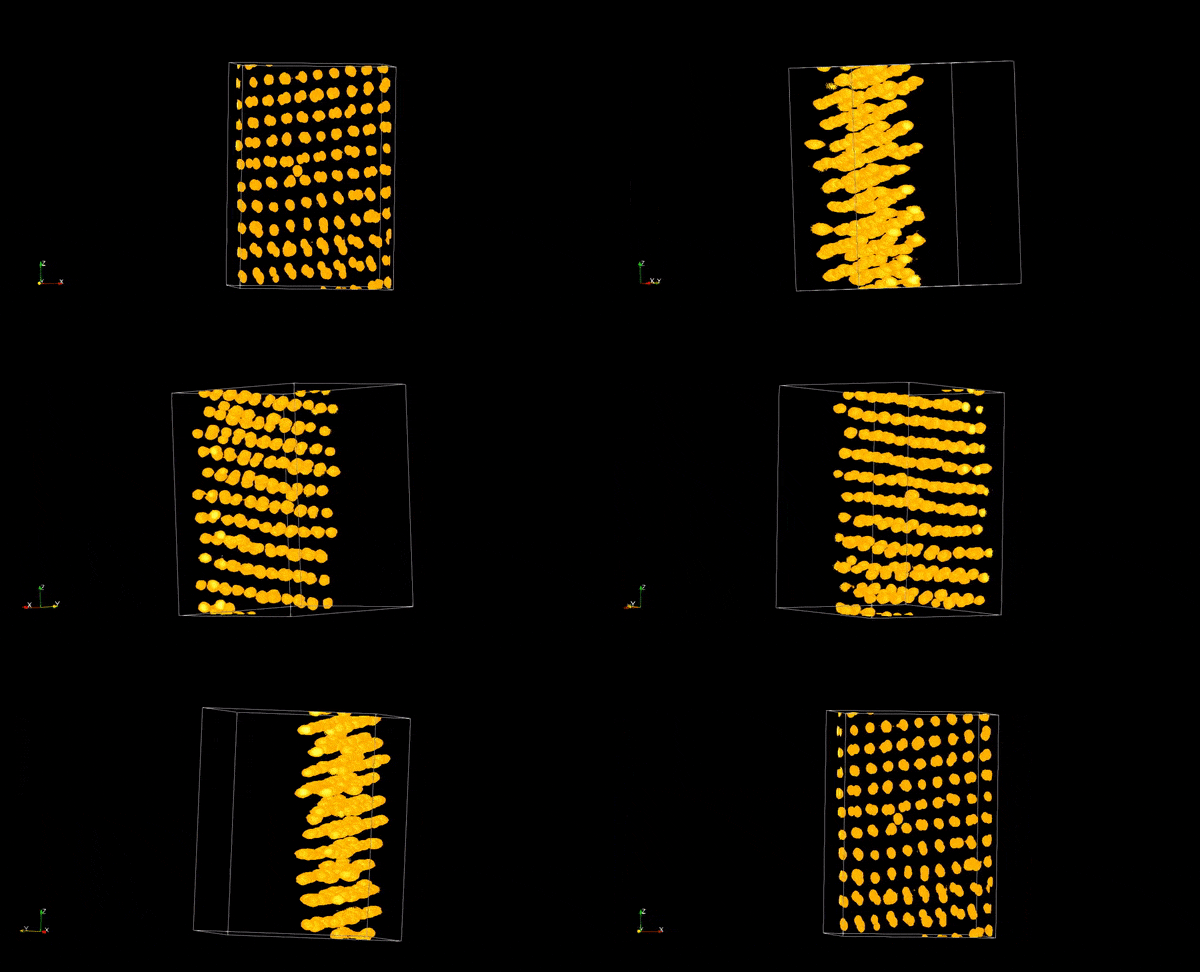
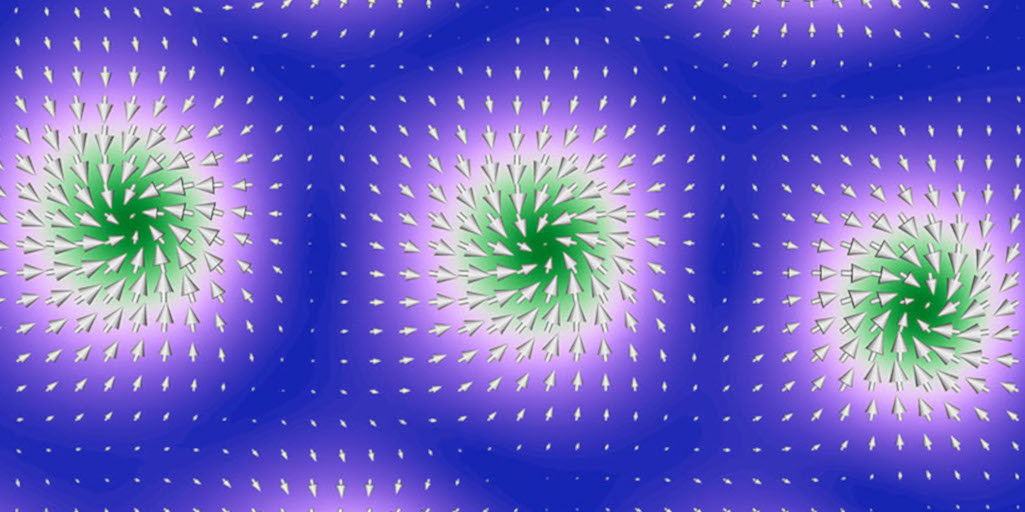
Research at the Advanced Light Source promises four-bit magnetic cells instead of the two-bit magnetic domains of standard magnetic memories. Magnetic vortices are whirlpools of magnetic field, in which electron spins point either clockwise or counterclockwise. In the crowded center of the whirlpool the spins point either down or up. These four orientations can represent separate bits of information in a new kind of memory, if they can be controlled independently and simultaneously.

MORE>

Comparing Proteins at a Glance

April 29, 2013

A revolutionary X-ray analytical technique enables researchers at a glance to identify structural similarities and differences between multiple proteins under a variety of conditions and has already been used to gain valuable new insight into a prime protein target for cancer chemotherapy.

MORE>

Surprising Control over Photoelectrons from a Topological Insulator

March 12, 2013

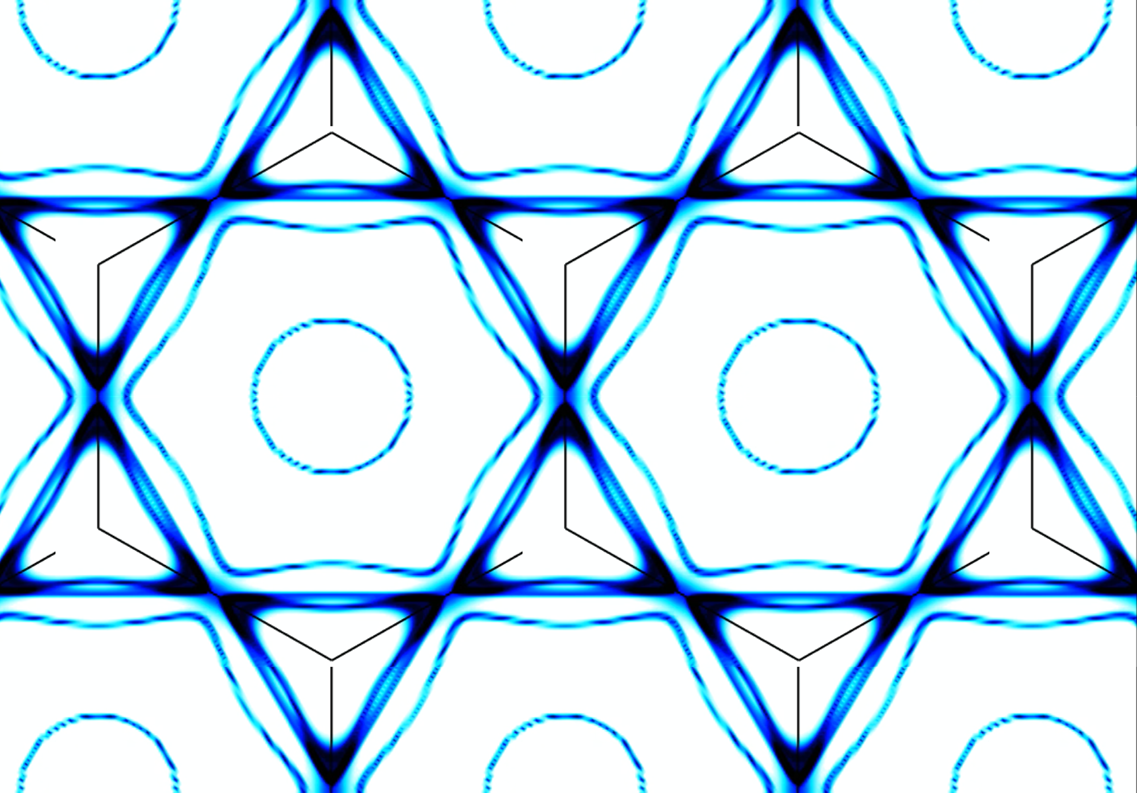
Electrons flowing swiftly across the surface of topological insulators (TIs) are “spin polarized,” their spin and momentum locked. This new way to control electron distribution in spintronic devices makes TIs a hot topic in materials science. Now Berkeley Lab scientists have discovered more surprises: contrary to assumptions, the spin polarization of photoemitted electrons from a topological insulator is wholly determined in three dimensions by the polarization of the incident light beam.

MORE>

Do We Owe Our Sense of Smell to Epigenetics?

March 4, 2013

Olfactory sensory neurons – nerve cells in the nose – directly sense molecules that convey scent, then send the signals to the brain. Biologists have long wondered how it’s possible for each nerve cell to be equipped with only one kind of olfactory receptor (OR). There are over a thousand different kinds of OR genes [...]

MORE>

Searching for the Solar System’s Chemical Recipe

February 20, 2013

The ratio of isotopes in elements like oxygen, sulfur, and nitrogen were once thought to be much the same everywhere, determined only by their different masses. Then isotope ratios in meteorites, interplanetary dust and gas, and the sun itself were found to differ from those on Earth. Planetary researchers now use Berkeley Lab’s Advanced Light Source to study these “mass-independent” effects and their origins in the chemical processes of the early solar system.

MORE>

Black Gold: Enabling Bright, High Rep-Rate Electron Beams

February 14, 2013

Free electron lasers (FELs) have proven their worth, but next-generation light sources will have to do better than produce ultrabright x-ray pulses 100 or so times a second. What’s needed is megahertz rep rate, a million times a second. Since it’s electrons that make the x-rays, the only way to achieve that kind of performance [...]

MORE>

Revealing the Secrets of Motility in Archaea

February 14, 2013

The protein structure of the archaellum, the motor that propels many species of Archaea, the third domain of life, has been characterized for the first time by a team from Berkeley Lab and the Max Planck Institute for Terrestrial Microbiology. A ring made of six identical proteins derives energy from hydrolyzing adenosine triphosate (ATP) and uses this energy to drive shape changes, both assembling and rotating the archaellum’s whiplike propeller.

MORE>

Blocking Infinity in a Topological Insulator

February 6, 2013

In bulk, topological insulators (TIs) are good insulators, but on their surface they act as metals, with a twist: the spin and direction of electrons moving across the surface of a TI are locked together. TIs offer unique opportunities to control electric currents and magnetism, and new research by a team of scientists from China [...]

MORE>

Synchrotron Infrared Unveils a Mysterious Microbial Community

January 22, 2013

A cold sulfur spring in Germany is the only place where archaea are known to dominate bacteria in a microbial community. How this unique community thrives and the lessons it may hold for understanding global carbon and sulfur cycles are beginning to emerge from research at the Advanced Light Source’s Berkeley Synchrotron Infrared Structural Biology facility.

MORE>

New Path to More Efficient Organic Solar Cells Uncovered at Berkeley Lab’s Advanced Light Source

January 7, 2013

Working at Berkeley Lab’s Advanced Light Source (ALS), an international team of scientists found that for highly efficient polymer/organic solar cells, size matters. Impure domains if made sufficiently small can lead to improved performances in polymer-based organic photovoltaics.

MORE>

A U.S. Department of Energy National Laboratory Operated by the University of California
UC logo
Questions & CommentsPrivacy & Security Notice