Although dark matter makes up most of the mass in our universe, it has never been directly observed. To hunt for lighter dark matter and other rare phenomena, researchers must solve a puzzle in their supersensitive detectors: an unexpected number of low-energy events, called the “low-energy excess” or LEE, that can obscure the rare signals they seek.
In a study published on Dec. 30, 2025, in Applied Physics Letters, researchers with the TESSERACT (Transition-Edge Sensors with Sub-EV Resolution And Cryogenic Targets) experiment identified one of the culprits behind the low-energy excess. They found that the noise comes not from the electronics or the surrounding environment, but from tiny bursts of vibrational energy within the silicon crystal of the detectors themselves. And the thicker the silicon, the more LEE events there are.
Since at least some LEE events come from tiny changes in the detector material itself, researchers estimate they also cause problems in superconducting qubits, the sensitive building blocks of quantum computers that are often made of silicon. The bursts of energy can create “quasiparticles” that disturb a qubit’s fragile quantum state, causing it to decohere or fail. So even in carefully shielded quantum systems, some errors could be coming from inside the house.
“Quantum computers could perform calculations our current systems can’t, but only if people can make qubits that are stable,” said Dan McKinsey, the director of TESSERACT and a scientist at the Department of Energy’s Lawrence Berkeley National Laboratory (Berkeley Lab), which leads the experiment. “Because the detectors we use for our dark matter experiment have a similar backbone to what is in qubits, by understanding a problem in particle physics, we’re also getting information on how to improve the quantum computing side.”
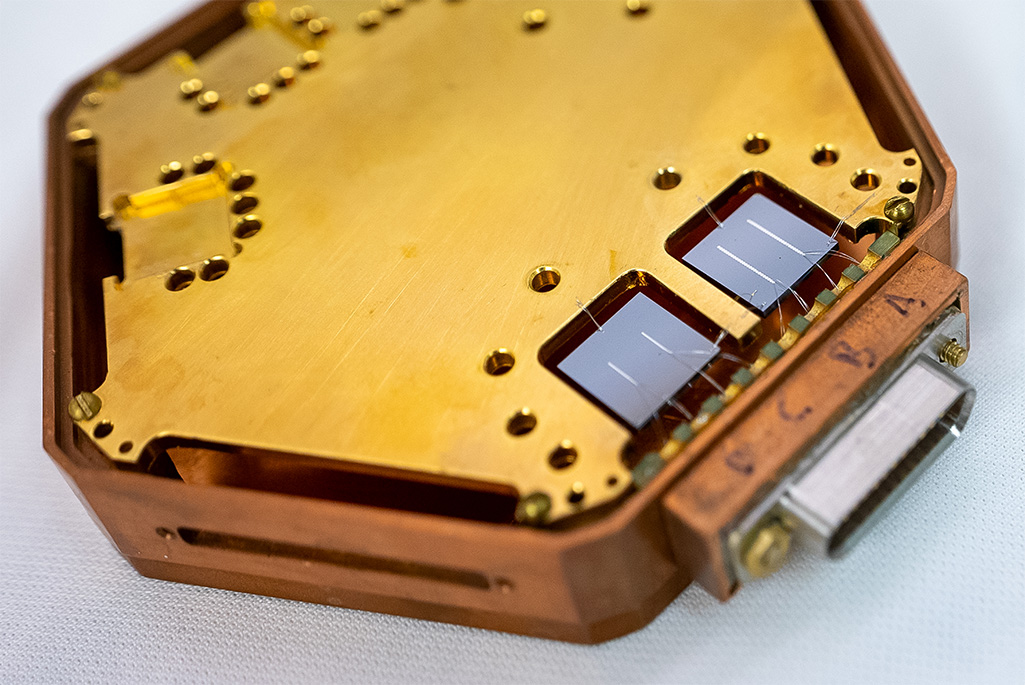
To pinpoint where LEE events were coming from, TESSERACT collaborators fabricated superconducting phonon sensors (which pick up quantum vibrations, or phonons) on two nearly identical silicon chips that were 1 and 4 millimeters thick. In both detectors, the number of events decreased over time as they were cooled, and the thicker chip saw four times as many low-energy events — pointing to the volume of silicon itself as the source, rather than outside causes.
Now that the scientific community knows the number of LEE events relates to how thick the silicon is, some groups will be able to improve their sensors simply by scaling back how much silicon they use. But it’s still just the first step in understanding exactly what causes the bursts of energy and finding an engineering solution to get rid of the background noise completely.
“Superconducting qubits for computers are designed to ignore the environment so that their quantum state survives,” said Matt Pyle, a TESSERACT collaborator, associate professor at UC Berkeley, and researcher at Berkeley Lab. “In contrast, our photon and phonon sensors use similar technology, but they’re designed to be incredibly sensitive to their environment so that they can sense dark matter. That makes our detectors unique and powerful tools for diagnosing environmental sources that cause decoherence and limit quantum computers.”
During the experiment, TESSERACT’s thinner detector also achieved a world-leading energy resolution of 258.5 millielectronvolts. That means it could distinguish between two events with energies differing by only a few hundredths of an electronvolt, several times smaller than the amount of energy carried by a single particle of visible light. That precision will allow scientists to distinguish extremely faint signals from background noise, essential for tracking down dark matter.
TESSERACT is currently in the prototype and construction phase, and will eventually be installed in France’s Modane Underground Laboratory. The TESSERACT collaboration also includes researchers at Argonne National Laboratory, Caltech, Florida State University, IJCLab (Laboratoire de Physique des 2 Infinis Iréne Joliot-Curie), IP2I (Institut de Physique des 2 Infinis de Lyon), LPSC (Laboratoire de Physique Subatomique et de Cosmologie), Texas A&M University, UC Berkeley, the University of Massachusetts Amherst, the University of Zürich, and QUP (the International Center for Quantum-field Measurement Systems for Studies of the Universe and Particles).
###
Lawrence Berkeley National Laboratory (Berkeley Lab) is committed to groundbreaking research focused on discovery science and solutions for abundant and reliable energy supplies. The lab’s expertise spans materials, chemistry, physics, biology, earth and environmental science, mathematics, and computing. Researchers from around the world rely on the lab’s world-class scientific facilities for their own pioneering research. Founded in 1931 on the belief that the biggest problems are best addressed by teams, Berkeley Lab and its scientists have been recognized with 17 Nobel Prizes. Berkeley Lab is a multiprogram national laboratory managed by the University of California for the U.S. Department of Energy’s Office of Science.
DOE’s Office of Science is the single largest supporter of basic research in the physical sciences in the United States, and is working to address some of the most pressing challenges of our time. For more information, please visit energy.gov/science.
Small But Mighty: TESSERACT Joins the Hunt for Dark Matter
LZ Sets a World’s Best in the Hunt for Galactic Dark Matter and Gets a New Look at Neutrinos from the Sun’s Core