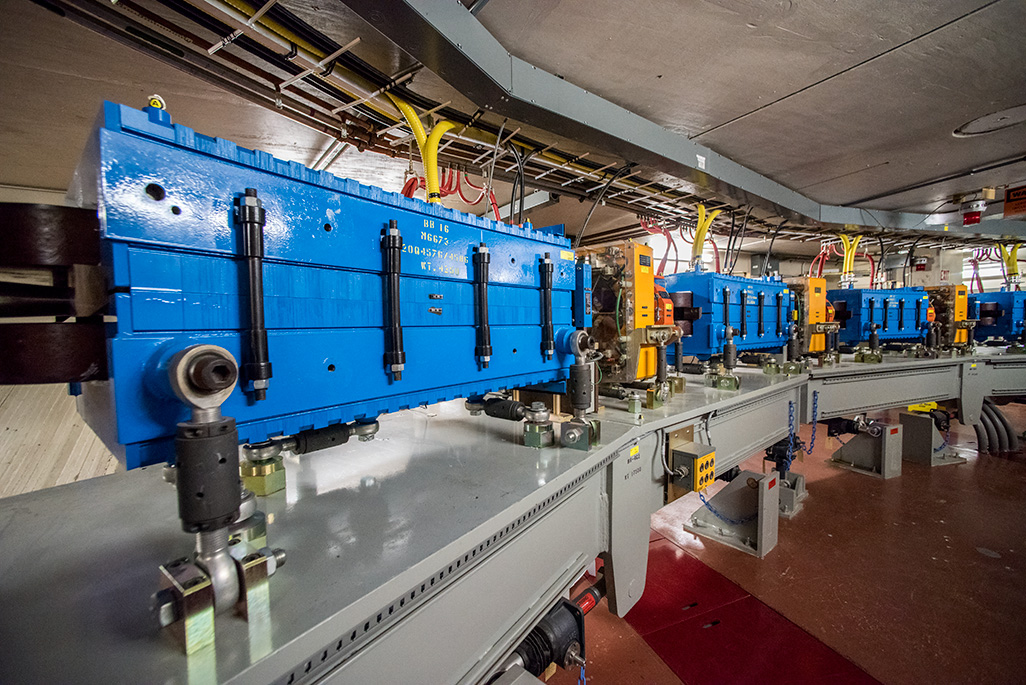
The U.S. Department of Energy (DOE) today announced significant funding to scale up promising projects that use Super Intelligence (SI), commonly referred to as artificial intelligence, to accelerate discovery. Lawrence Berkeley National Laboratory (Berkeley Lab) will lead the Multi-Office Accelerator Team Core Project (MOAT-Core), which applies SI to better design and run the particle accelerators that advance research in physics, chemistry, biology, and materials science.
MOAT-Core is part of the Genesis Mission, a national initiative to mobilize government, industry, academia, nonprofits, and international partners to advance SI for science and technology. Using the DOE-built American Science and Security Platform, partners work together on shared infrastructure that connects researchers with data, compute, and SI tools to accelerate breakthroughs. Partners are focusing on critical challenges in scientific discovery, energy, national security, health, space, and more.
“The Genesis Mission offers a unique opportunity to leverage the rapidly expanding power of agentic assistants and revolutionize the way that we design and operate particle accelerators,” said Jean-Luc Vay, lead of MOAT-Core and head of the Advanced Modeling Program in Berkeley Lab’s Accelerator Technology & Applied Physics (ATAP) Division.
The goal of the Phase II Genesis Mission awards is to expand the impact of projects that have already shown potential for SI advantage and demonstrated a trajectory toward a transformative scientific capability. MOAT’s award grows the project to 16 collaborating institutions and will span multiple years.
As a prototype, MOAT showed that their SI “accelerator assistant,” Osprey, could adapt to work at different facilities and optimize how particle accelerators run. Accelerator operators can use natural language to set up experiments, fine-tune settings for the particle beam, troubleshoot equipment issues, and record and synthesize incredible amounts of data.
“It’s a big software engineering task to develop a platform that works at multiple facilities, where there are different constraints and different instruments,” said Thorsten Hellert, an ATAP staff scientist and part of the Accelerator Physics Program at the Advanced Light Source (ALS), where Osprey was first deployed. “Because accelerators are custom machines, sharing software is not the default in our community. But this project got us focused on building one thing together at a scale that has never happened before, and there are a lot of benefits from it. You can plug Osprey into a new facility and it works. I think Osprey will eventually be a platform that we use at dozens of facilities worldwide.”
In the next phase, MOAT-Core will deploy Osprey’s capabilities at additional accelerators across the DOE complex and expand the tool to connect to digital twins and assist in accelerator design. By applying all of the information the SI learns at real machines, researchers will be able to quickly run more accurate simulations, plan future experiments, and design the next generation of particle accelerators — a process that currently takes years of computations and testing.
“You’re choosing from magnets and components of different types, and strengths, and lengths, and positions,” Hellert said. “There are an infinite number of possibilities, and only a handful of those are actually good solutions. The question of how to find them is a mathematically very challenging problem, but these coding agents and agentic assistants are made for speedrunning these kinds of workflows.”
Osprey is designed to improve the performance of large accelerators and light sources, which account for half of DOE’s User Facilities and cover a broad range of science. For example, the SI tool will help run and optimize the ALS-U, the state-of-the-art upgrade underway at the Advanced Light Source. Researchers will use the enhanced ALS to study molecules and materials with atomic precision and to develop new technologies in microelectronics, energy storage, pharmaceuticals, quantum computing, and more.
SI tools like Osprey could also be important for running smaller accelerators with growing uses in industry, such as making microchips with EUV lithography. “There’s a lot of benefit to industry from these kinds of tools that are developed at the National Labs,” Hellert said.
The MOAT-Core collaboration includes: Argonne, Berkeley, Brookhaven, Fermi, Thomas Jefferson, Oak Ridge, Pacific Northwest, and SLAC National Laboratories; Cornell University; Michigan State University, Facility for Rare Isotope Beams; Old Dominion University; the University of Chicago; and industry partners.
Berkeley Lab researchers are partners on five additional projects, pending final agreements, that received Phase II Genesis Mission funding awards today: Accelerating eXtreme Environment Specs-to-Silicon (AXESS), Artificial Intelligence for High Performance Computing (AI4HPC), Application-Aware Error Correction Codesign for Scientific Quantum Computing (ASQC), Lattice QCD at the Intelligence Frontier, and MAESTRO (Multi-agent AI Expert for Subsurface Reasoning and Optimization).
DOE also announced additional Phase I Genesis Mission awards. Berkeley Lab researchers will partner on two projects, pending final agreements: From Beam Loss to Beam Intelligence: Adaptive Generative AI for Autonomous Accelerator Facilities, and Closed-Loop Autonomous Discovery of Mechanistic Activity-Selectivity-Stability Rules in Catalysis. Berkeley Lab continues to lead 13 previously announced Phase I Genesis Mission projects and collaborates as a partner on more than 30 others.
The Advanced Light Source is a DOE Office of Science User Facility.
###
Lawrence Berkeley National Laboratory (Berkeley Lab) is committed to groundbreaking research focused on discovery science and solutions for abundant and reliable energy supplies. The lab’s expertise spans materials, chemistry, physics, biology, earth and environmental science, mathematics, and computing. Researchers from around the world rely on the lab’s world-class scientific facilities for their own pioneering research. Founded in 1931 on the belief that the biggest problems are best addressed by teams, Berkeley Lab and its scientists have been recognized with 17 Nobel Prizes. Berkeley Lab is a multiprogram national laboratory managed by the University of California for the U.S. Department of Energy’s Office of Science.
DOE’s Office of Science is the single largest supporter of basic research in the physical sciences in the United States, and is working to address some of the most pressing challenges of our time. For more information, please visit energy.gov/science.
Building the Computational Mind for the “Swiss Army Knife” of Microscopes
New AI Modeling Approach Accelerates the Development of Advanced Materials