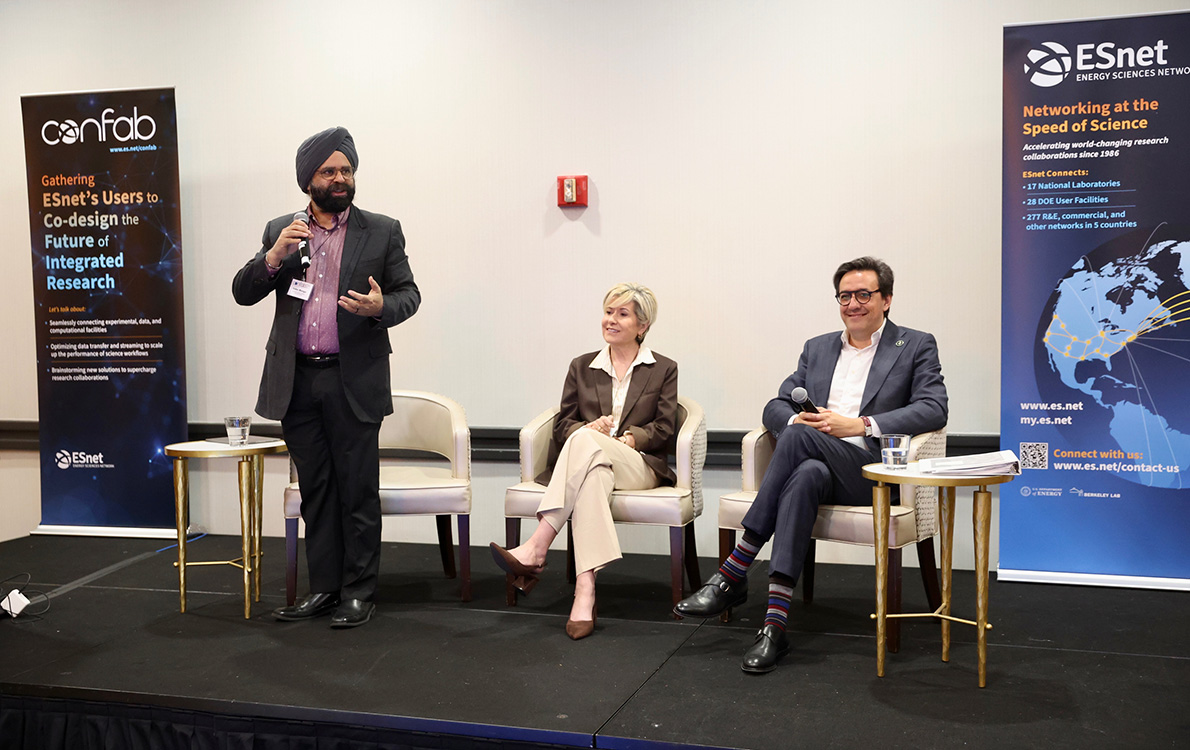
As the Director of the Scientific Networking Division at Lawrence Berkeley National Laboratory (Berkeley Lab) and Executive Director of the Energy Sciences Network (ESnet), Inder Monga is an expert in keeping the flow of scientific data running 24/7. ESnet is the Department of Energy’s High Performance Network user facility, which provides high-performance data transfer connections linking all 17 national laboratories and 28 user facilities, scientific instruments, universities, and other research institutions across the world.
In addition to leading ESnet, he is also the principal investigator for the Quantum Application Network Testbed for Novel Entanglement Technology (QUANT-NET) project, which aims to build a quantum networking testbed for distributed quantum computing; and co-PI of FABRIC, the National Science Foundation’s testbed project dedicated to advancing the science of networking for collaborative and distributed research applications.
Monga’s expertise in scientific networking led him to being named Deputy Project Lead of the American Science Cloud (AmSC), a U.S. Department of Energy (DOE)-governed federated cloud infrastructure that is unifying data, models, and high-performance computing resources to accelerate DOE science. Launched in October 2025, AmSC is a cornerstone of the Genesis Mission, a national initiative to advance artificial intelligence in order to accelerate scientific discovery and deliver solutions to challenges in science, energy, and national security.
In this Q&A, Monga shares his perspective on AmSC’s critical role in driving scientific innovation forward, and how Berkeley Lab is helping to advance it.
Q: Why is the American Science Cloud (AmSC) an important component of the Genesis Mission?
Monga: As the foundational infrastructure layer for open science within the Genesis Mission platform, the AmSC project unifies extraordinary but fragmented national capabilities — massive experimental datasets and computational power — into a cohesive, AI-ready platform for science and innovation. Right now, the 17 DOE national labs and 28 user facilities connect to each other across the ESnet network, but they require dozens of different login systems and interfaces, among other challenges. The AmSC connective fabric includes a common identity layer, interoperable service interfaces across science collaborations, and AI-enabled orchestration services, intelligent storage, and other networking services that will make this distributed DOE infrastructure behave as a single, coherent system. This same connective fabric has also been extended to give scientists access to commercial cloud services and frontier AI models as well.
“As the scientific landscape shifts toward data-intensive, autonomous discovery, Berkeley Lab staff are ensuring the Genesis Mission platform, including AmSC, is built to solve the most complex challenges facing modern research.” – Inder Monga, ESnet Executive Director and American Science Cloud Project Deputy
Q: How is Berkeley Lab playing a significant role in the AmSC effort?
Monga: At Berkeley Lab, we’re contributing across all dimensions of the project, from project and product leadership to science use cases, including, for example, SYNAPS-I (SYnergistic Neutron and Photon Science – Intelligence), a multi-lab AI platform that embeds artificial intelligence into particle accelerators and synchrotrons. SYNAPS-I will compress experimental data analysis from months to near real time and make these massive synchrotron and neutron user facilities function more like “self-driving” laboratories.
Several Berkeley Lab staff members serve in leadership roles for the project and are members of the AmSC Science Council, and dozens of others are developing these foundational architecture and software integration capabilities. Berkeley Lab scientists from the Advanced Light Source, Joint Genome Institute, and other research facilities are providing both the data and the scientific questions that are driving the prioritization and development of the AmSC features. OPAL (the Orchestrated Platform for Autonomous Laboratories to Accelerate AI-Driven BioDesign) and MOAT (the Multi-Office particle Accelerator Team) are two big examples.
Q: How does Berkeley Lab’s expertise and capabilities make the lab well positioned to contribute to the Genesis Mission?
Monga: As the scientific landscape shifts toward data-intensive, autonomous discovery, Berkeley Lab staff are ensuring the Genesis Mission platform, including AmSC, is built to solve the most complex challenges facing modern research. I know others at the lab will be talking about contributing to the Transformational AI Models Consortium (ModCon), the cornerstone of the Genesis Mission’s AI models and data efforts. Our work on the AmSC side can be viewed as three pillars:
First, user-driven innovation. By defining real-world science use-cases around Scientific User Facilities (SUFs), Berkeley Lab researchers along with partners from other national labs are advancing the feature development and prioritization of the AmSc platform’s capabilities, ensuring it delivers immediate, tangible value to the scientific community.
Second, Berkeley Lab is providing the core infrastructure backbone for AmSC. By integrating specialized high-performance computing from NERSC (and other DOE leadership computing facilities) with next-generation networking via ESnet, we are creating a seamless environment for data-driven research.
Lastly, we’re spearheading the software integration and scalability efforts necessary to make the AmSC platform cohesive. Through science collaborations not only with the AmSC SUF Infrastructure Partners (SUF IPs) but also through contributions from the High Performance Data Facility project, we are harmonizing diverse experimental data streams, making the dream of an “AI-ready” national infrastructure a reality. It is a big effort, but we’re proud to be part of it.
###
Lawrence Berkeley National Laboratory (Berkeley Lab) is committed to groundbreaking research focused on discovery science and solutions for abundant and reliable energy supplies. The lab’s expertise spans materials, chemistry, physics, biology, earth and environmental science, mathematics, and computing. Researchers from around the world rely on the lab’s world-class scientific facilities for their own pioneering research. Founded in 1931 on the belief that the biggest problems are best addressed by teams, Berkeley Lab and its scientists have been recognized with 17 Nobel Prizes. Berkeley Lab is a multiprogram national laboratory managed by the University of California for the U.S. Department of Energy’s Office of Science.
DOE’s Office of Science is the single largest supporter of basic research in the physical sciences in the United States, and is working to address some of the most pressing challenges of our time. For more information, please visit energy.gov/science.
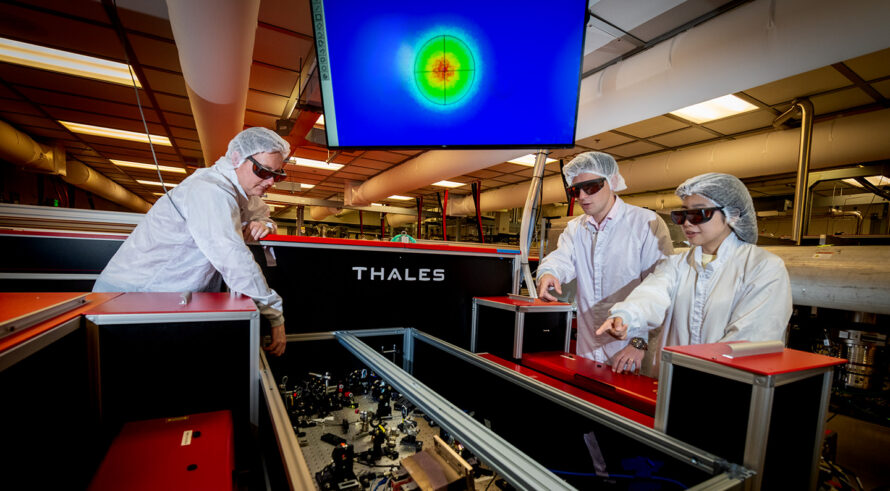
AI for Smarter, More Powerful, More Efficient Particle Accelerators
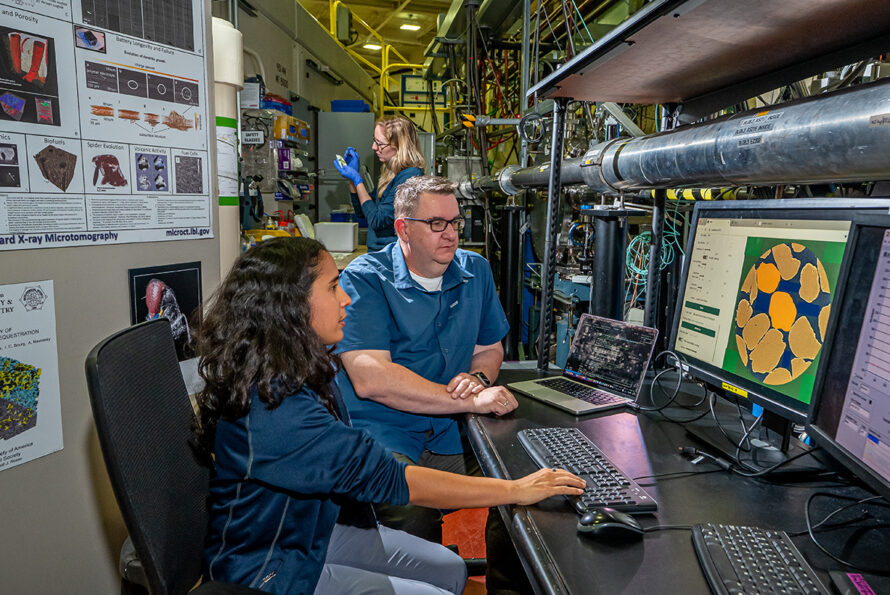
How a Machine Learning Pipeline Could Accelerate Innovation