
Key Takeaways
- Berkeley Lab researchers developed computational tools to process the massive datasets generated by MOSAIC, a reconfigurable microscope that combines more than ten advanced imaging techniques into one compact instrument.
- By combining techniques into one tool, researchers can track how molecules, cells, and tissues in the same specimen change over time.
- MOSAIC’s enormous, diverse datasets could help train future biological foundation models and vision-language models that could power self-driving laboratories, a goal that depends on significant investment in AI and GPU computing resources.
Biology doesn’t happen at one scale. Molecular interactions unfold in milliseconds and nanometers, while disease-associated change such as in Alzheimer’s spreads across millimeters of brain tissue. Understanding complex biological systems requires scientists to watch both — ideally at the same time and with the same sample. Historically, this has meant shuttling samples between specialized instruments, often damaging biological context and slowing results. There’s also a common crux across microscopes: the closer you look at living tissue, the more the image blurs, and the more detail you capture, the more overwhelming the resulting data becomes.
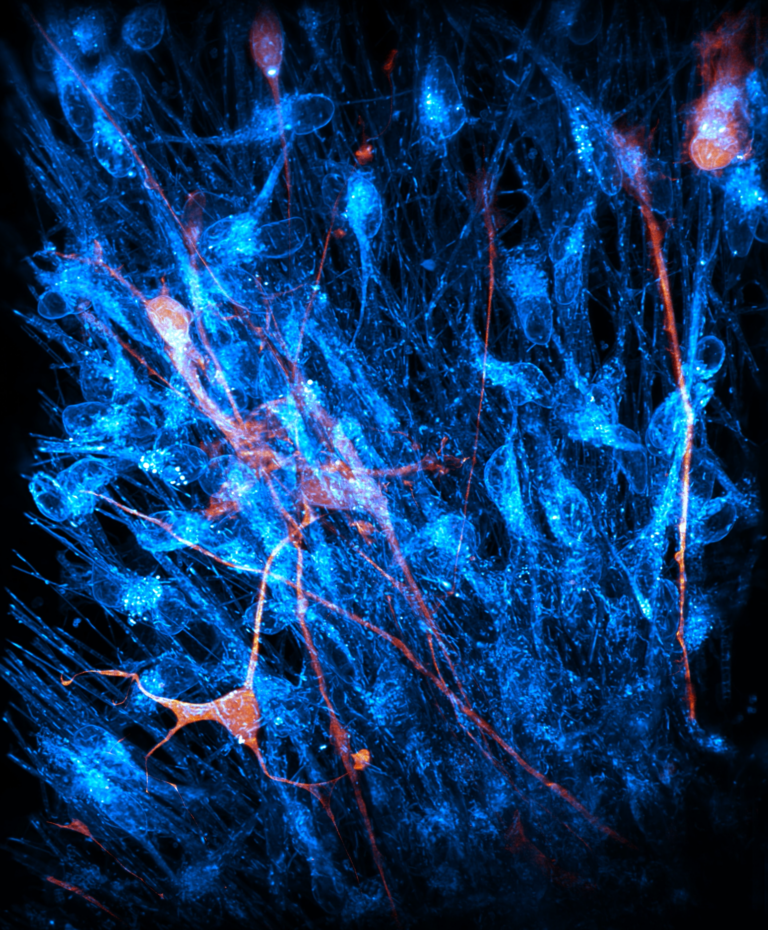
An image of a living brain organoid derived from stem cells, showing mitochondrial transport in cyan and neuronal dynamics in orange. Only about 20% of the cells in the organoid are stained. (Credit: Fu, Liu, Milkie, Ruan et al., Nature Methods, 2026)
A new instrument aims to address these problems — and has revealed a third, arguably harder challenge that Berkeley Lab is uniquely positioned to address.
Researchers at Lawrence Berkeley National Laboratory (Berkeley Lab) and collaborating institutions have developed the Multimodal Optical Scope with Adaptive Imaging Correction (MOSAIC) — a reconfigurable microscope that consolidates more than ten imaging techniques into one compact instrument. It processes its massive datasets using computational tools developed at Berkeley Lab, funded by a Laboratory Directed Research and Development (LDRD) award and supported by the Perlmutter supercomputer at the National Energy Research Scientific Computing Center (NERSC).
Featured on the cover of Nature Methods, MOSAIC allows scientists to track biological processes across scales and compare imaging methods on the same sample. It generates data at a pace that is pushing the boundaries of what biology can discover.
“MOSAIC can generate up to four terabytes of data per hour — far beyond what conventional processing workflows or human inspection can handle,” said Srigokul “Gokul” Upadhyayula, a faculty scientist in the Molecular Biophysics and Integrated Bioimaging Division and co-corresponding author. “The microscope is only as useful as our ability to process those data and extract biological meaning from them. Berkeley Lab’s expertise in high-performance computing and large-scale data analysis is essential to closing that gap.”
How MOSAIC works
MOSAIC grew from the adaptive-optical lattice light-sheet microscope reported by Nobel laureate Eric Betzig, Upadhyayula, and their colleagues in 2018. That earlier system delivered exceptional performance but was so large it occupied a 10-foot by 4-foot optical table. As demand from the broader research community grew, the team designed the MOSAIC to retain and expand those capabilities while reducing the instrument’s footprint.
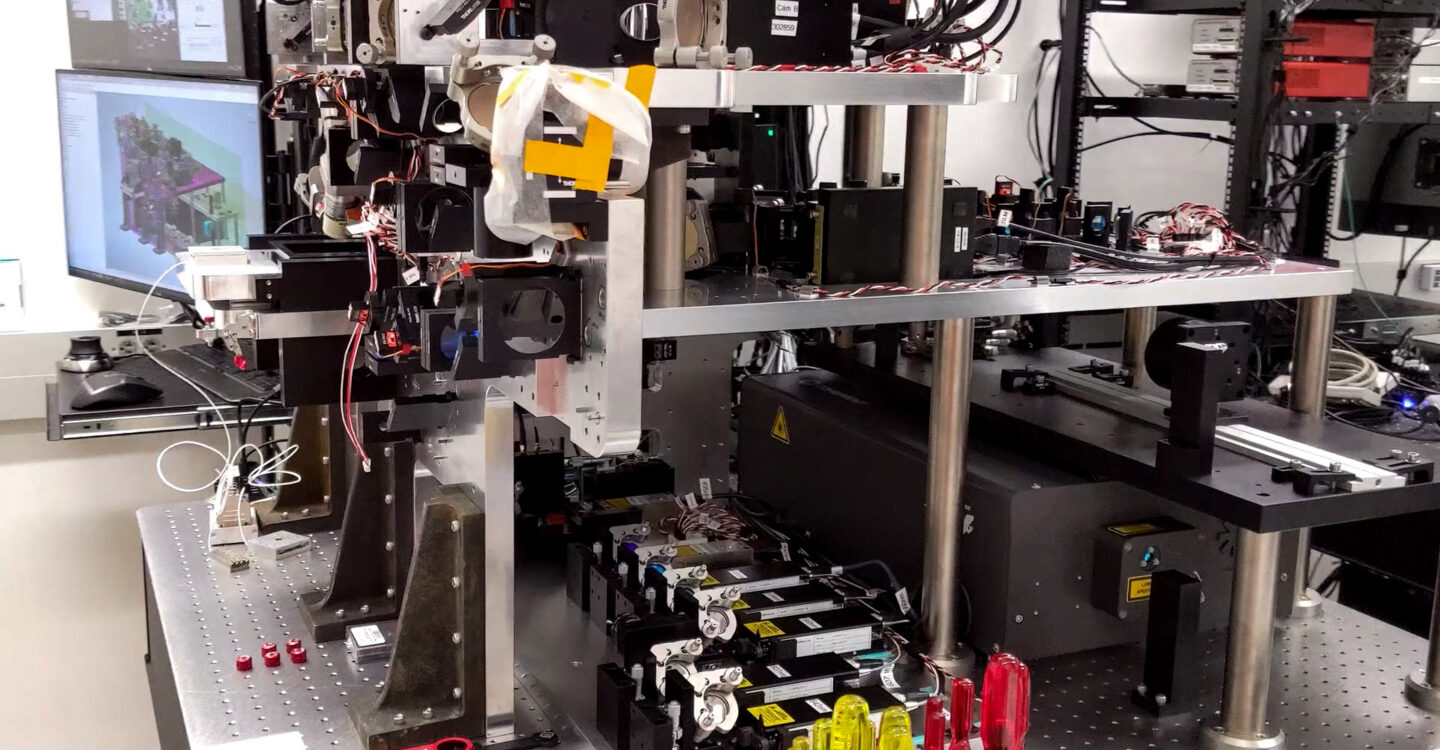
“MOSAIC has been built over a dozen times in different places with over 50 research licenses already shared. We also created comprehensive documentation on how to build this instrument — think an IKEA-style instruction set geared towards a scientist who has no deep optical expertise but is willing to learn.”
MOSAIC’s main innovation is that it can be quickly reconfigured in two to five seconds to switch between a dozen distinct imaging modes. The team designed a smart modular system where the same lasers, mirrors, cameras, and computational hardware serve multiple imaging functions through a custom optical switching system. Critically, every one of those modes is enhanced with adaptive optics: a technology borrowed from astronomers who developed it to sharpen images of distant stars blurred by Earth’s atmosphere. This corrects blurring caused by aberrations in the living tissue itself.
“ Sample-induced aberrations distort and redirect light, reducing both signal and resolution,” said Upadhyayula. “Adaptive optics measures those distortions and corrects them. It is like turning on the windshield wipers while driving in the rain: the information is present all along, just obscured.”
MOSAIC also relies on fluorescent molecules that allow biologists to mark specific cellular structures and molecular activities in living cells, fast and gentle light-sheet imaging that captures cellular dynamics with minimal stress or damage, and high-speed data transfer infrastructure capable of moving and processing massive imaging datasets.
What becomes visible when you clear the windshield?
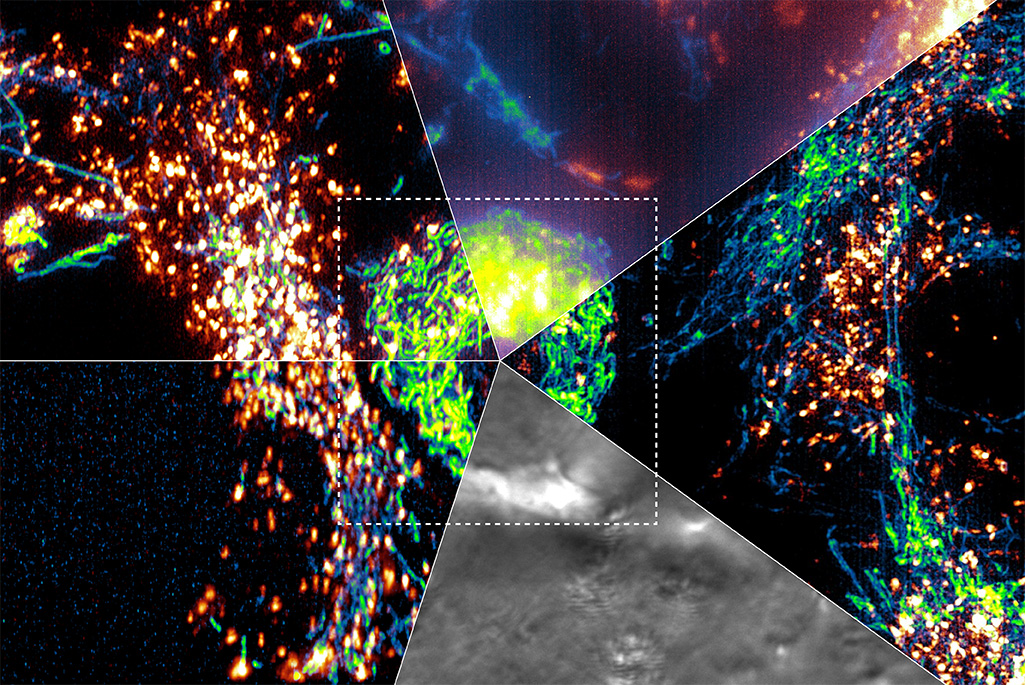
MOSAIC’s ability to image with minimal invasiveness at large scales over long durations has already enabled several experiments: tracking single molecules in living cells, observing organelle dynamics in developing zebrafish embryos, mapping neuronal architecture in expanded human brain tissue from a person with Alzheimer’s, and imaging neural activity in live mouse brains. In that last application, adaptive optics correction revealed roughly 2.5 times more detectable neural calcium events than imaging without it — suggesting conventional microscopy has been quietly undercounting brain activity.
MOSAIC is also the instrument that powered a related study on Volumetric Imaging via Photochemical Sectioning (VIPS), published in Science in 2025. That project used MOSAIC and the computational tools developed at Berkeley Lab to image two complete adult mouse olfactory bulbs at nanoscale resolution, generating roughly a petabyte of data in approximately two weeks. Analyzing it took two years: an illustration of the gap between what these instruments can see and what researchers can currently process.
“ The bottleneck is no longer our ability to acquire the data,” said Upadhyayula. “These microscopes can generate massive datasets at staggering rates. The key bottleneck is turning dense five-dimensional observations into biological understanding.”
Berkeley Lab’s contribution helps to target this gap.
Round-the-clock data collection for biological AI
Supported by an LDRD award, Eric Betzig and Upadhyayula’s group developed PetaKit5D, an open-source software toolkit that can handle MOSAIC’s terabyte-per-hour output in real time and cuts processing costs by more than an order of magnitude compared to previous approaches. The team also secured computing allocations on the Perlmutter supercomputer at NERSC to process and visualize portions of the largest datasets. But processing data efficiently is only half the equation. The other half is generating enough of it — consistently, at scale, and of sufficient quality — to train the kind of AI model that could one day make sense of it all.
At UC Berkeley, two MOSAIC instruments now run around the clock, capturing the five-dimensional data — three spatial dimensions, time, and molecular identity — that will be needed to train a new state-of-the-art AI model.
The data flowing from those instruments already represents a fundamental shift in how biology can be practiced. For the first time, researchers can watch in vivo biochemistry unfold inside cells living within their native tissues, inside a living organism.
What comes next, he believes, could be transformative: a vision language model that reasons natively over biology, connecting what it sees with molecular identity, experimental context, and prior biological knowledge to determine which observations matter and which experiments should come next.
“Connected to automated microscopes, sample handling, and perturbation systems, that capability could provide the foundation for self-driving biological laboratories — and fundamentally change the rate at which we can make discoveries,” said Upadhyayula.
###
Lawrence Berkeley National Laboratory (Berkeley Lab) is committed to groundbreaking research focused on discovery science and solutions for abundant and reliable energy supplies. The lab’s expertise spans materials, chemistry, physics, biology, earth and environmental science, mathematics, and computing. Researchers from around the world rely on the lab’s world-class scientific facilities for their own pioneering research. Founded in 1931 on the belief that the biggest problems are best addressed by teams, Berkeley Lab and its scientists have been recognized with 17 Nobel Prizes. Berkeley Lab is a multiprogram national laboratory managed by the University of California for the U.S. Department of Energy’s Office of Science.
DOE’s Office of Science is the single largest supporter of basic research in the physical sciences in the United States, and is working to address some of the most pressing challenges of our time. For more information, please visit energy.gov/science.