
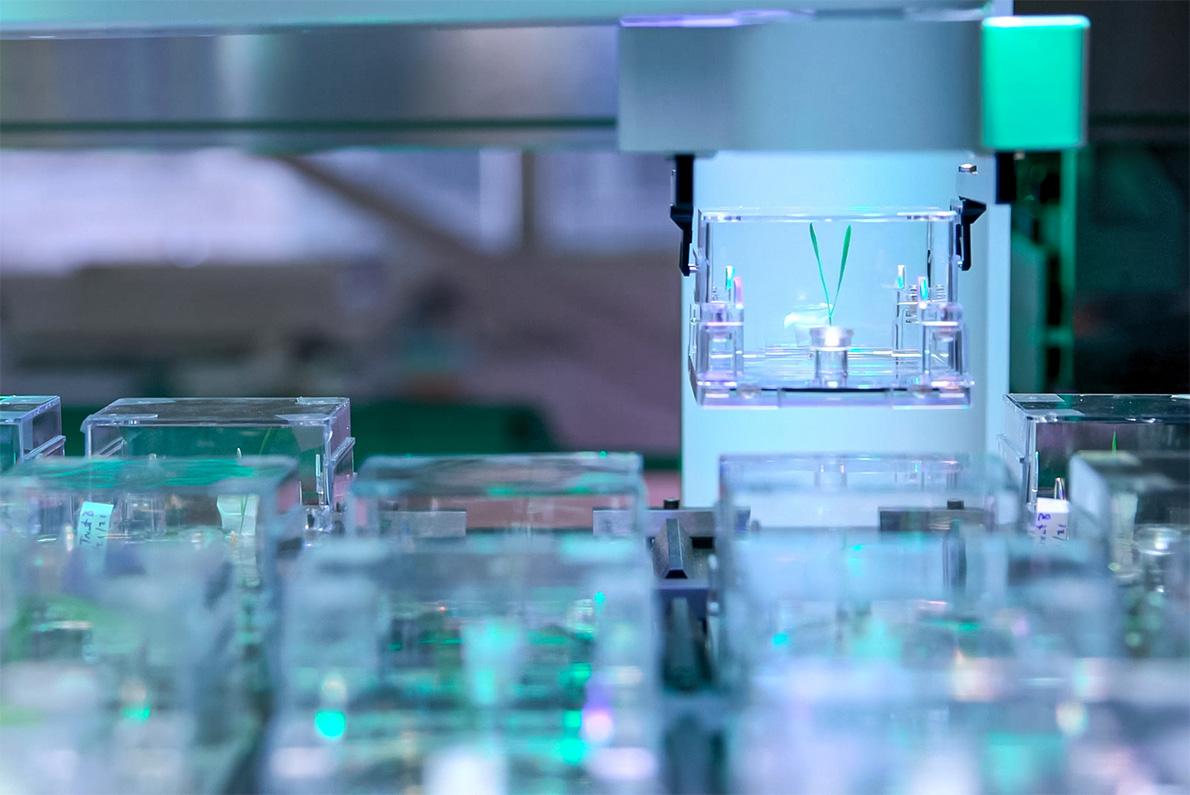
To harness biological systems (plants and microbes) for next-generation energy production and advanced materials, researchers are looking to beneficial plant-microbe interactions. Because these are complex systems, it has proven difficult to reproducibly control exactly which microbes are present. And, subtle differences in materials, methods, or even the hands of the researchers themselves can lead to inconsistent results. This makes it difficult to replicate previous work, significantly slowing the leap from scientific discovery to practical application.
Researchers at Lawrence Berkeley National Laboratory (Berkeley Lab) are overcoming this bottleneck by addressing a multi-layered challenge: building reliable physical hardware, engineering accurate visual sensors, and developing predictive algorithms. Their solution, EcoBOT, stands out from typical plant phenotyping facilities by integrating these distinct components into a reliably automated workflow under strictly sterile conditions.
EcoBOT takes specialized growth chambers, called EcoFABs, and integrates them with machine-learning tools that autonomously guide the discovery cycle. This system uses advanced imaging to regularly scan the entire plant—from the tips of its leaves to the bottom of its roots. By using Gaussian Process models and AI analysis tools, it can quickly analyze and model this visual data to calculate the most informative next steps. This directs the automated hardware to determine exactly how plants adapt to environmental stressors, establishing the crucial microbe-free baseline needed to eventually study plant-microbe interactions and engineer better bioenergy crops.
“Even with a simple biological system, the number of potential variables in an experiment can be overwhelming. If two different researchers tweak even a minor parameter, they could get completely different results,” said Peter Andeer, a researcher in the Environmental Genomics and Systems Biology (EGSB) Division who contributed to the design of EcoFABs and EcoBOT. “EcoBOT gives us speed, but more importantly, visibility. Without a system to keep track of the big picture, you just end up with disconnected observations, and no one can make sense of it.”
EcoBOT’s algorithmic engines
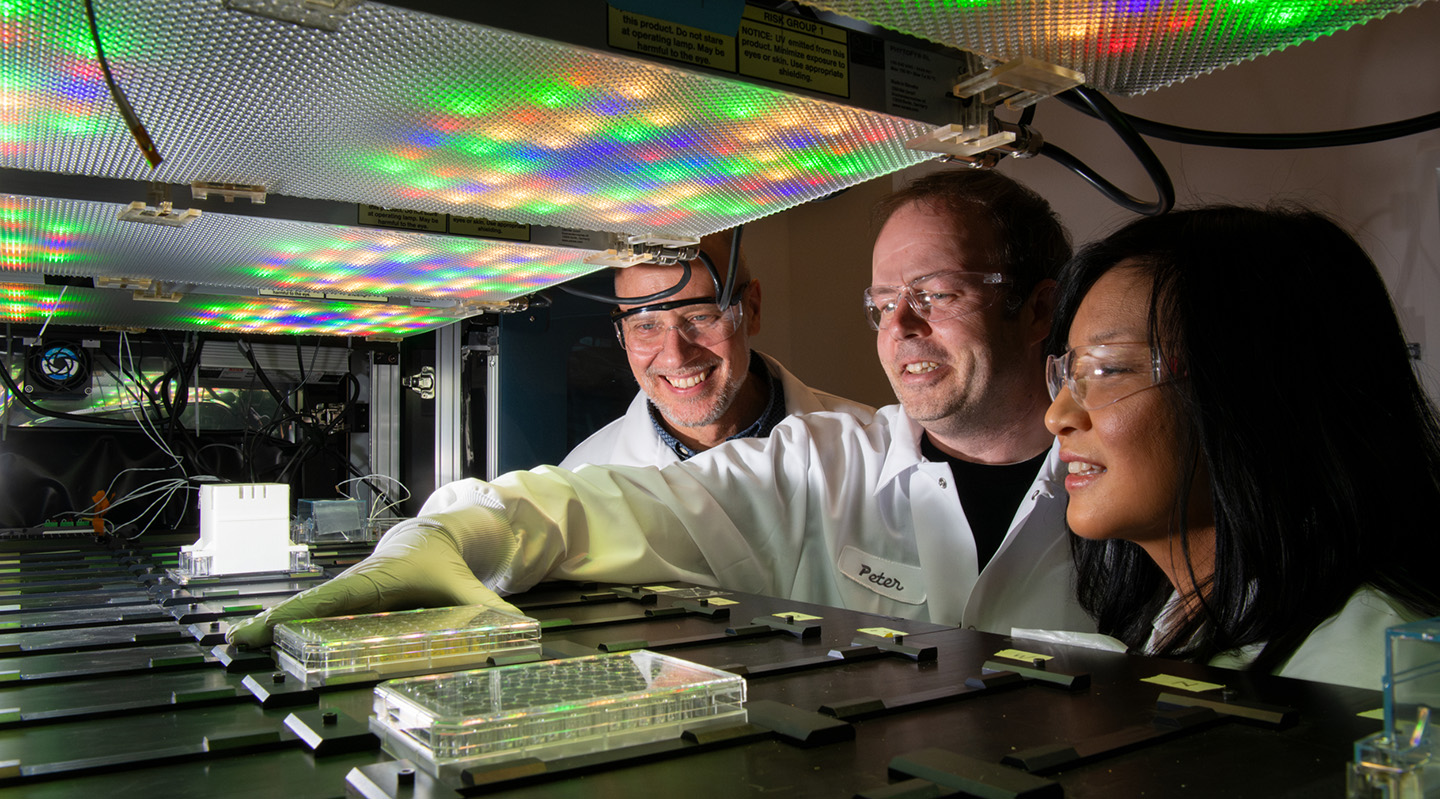
To illustrate how EcoBOT couples continuous measurement, adaptive modeling, and experimental redesign, the Berkeley Lab researchers used the system to observe how the model grass Brachypodium distachyon responds to environmental stressors such as nutrient deprivation and copper toxicity. In a traditional workflow, researchers might test a random spread of copper concentrations and wait weeks to measure the results. But inside EcoBOT’s compact cabinet, a robotic arm can autonomously manage over 150 individual EcoFABs simultaneously across three shelves. This robotic hardware doesn’t just automate the process; it intentionally maintains a highly controlled physical environment, providing the necessary foundation for the system-level modeling and downstream adaptive decision-making.
Historically, extracting continuous data from that many biological environments would have been a grueling, manual task prone to human error. To solve this, researchers equipped EcoBOT with a suite of Berkeley Lab-developed deep learning tools that serve as the system’s digital eyes. Addressing this sensing challenge required developing sophisticated new computer vision algorithms capable of reliably translating complex, noisy biological imagery into precise measurements.
Below ground, a tool called RhizoNet serves as an automated root tracker. Rather than relying on inconsistent manual interpretation of root images, RhizoNet uses neural-network-based segmentation to digitally separate fragile plant roots from the noisy background of the hydroponic fluid in a standardized and reproducible way. In validation tests, it successfully standardized the analysis of thousands of images, precisely tracking root growth dynamics across all the different copper treatments. Above ground, a computer vision tool called EcoSpec scans the plant’s shoots and analyzes complex, multi-wavelength hyperspectral images to monitor plant health. This tool has demonstrated high accuracy in high-throughput monitoring—while maintaining consistency across longitudinal measurements.
The EcoBOT becomes a true self-driving laboratory through the continuous interaction between its physical infrastructure, sensing systems, and adaptive modeling framework. The robotic hardware stabilizes the experimental environment, the imaging systems convert plant behavior into quantitative measurements, and gpCAM uses those measurements to identify where uncertainty is highest and determine which experiments should be performed next. Using Gaussian-process-based modeling, gpCAM analyzes preliminary experimental results, estimates uncertainty across the experimental landscape, and calculates the next copper concentrations that are likely to be most informative. By iteratively targeting these knowledge gaps, this autonomous approach improved the predictive accuracy of the plant biomass models by more than thirty percent. Training and processing the complex visual data for these advanced machine learning models requires massive computational power, which the team accesses using supercomputers at the National Energy Research Scientific Computing Center (NERSC).
“This level of automation now positions us to go after our long-term goal of using it to help elucidate beneficial plant-microbe interactions,” said Andeer. “I was actually collecting data while on the other side of the country, just by logging in and hitting ‘go.’ We no longer have to arrange for a team of research assistants to take individual measurements and hope they are recorded consistently. EcoBOT feeds those measurements directly into our models. And because it all happens inside the sterile EcoFAB environment, we can guarantee there are no outside microbes influencing the results, which is impossible in a greenhouse.”
Andeer notes that Berkeley Lab’s culture of team science was essential to realizing this vision. Bringing the self-driving lab to life required a collaboration of plant biologists, robotics engineers, and mathematicians from the Lab’s CAMERA team.
“We originally built gpCAM as open-source software because researchers at massive experimental facilities were simply drowning in data,” said Marcus Noack, a researcher in the Applied Mathematics and Computational Research (AMCR) Division and CAMERA, as well as the developer of gpCAM. “When you are exploring a vast, uncharted experimental landscape, measuring everything is impossible. Instead, gpCAM allows the instrument to calculate its own uncertainty and pinpoint the exact data points needed to complete the map. Whether you are scanning a 2D material or testing copper toxicity in an EcoFAB, the AI actively steers the experiment so we can learn as much as possible, as efficiently as possible.”
Reliable hardware and reproducible results
The success of EcoBOT’s AI is actually built on years of work by the Department of Energy-funded TEAMS project to help address the reproducibility crisis—the frustrating reality that an experiment in one laboratory often yields conflicting results when attempted in another, simply due to invisible environmental shifts or human handling.
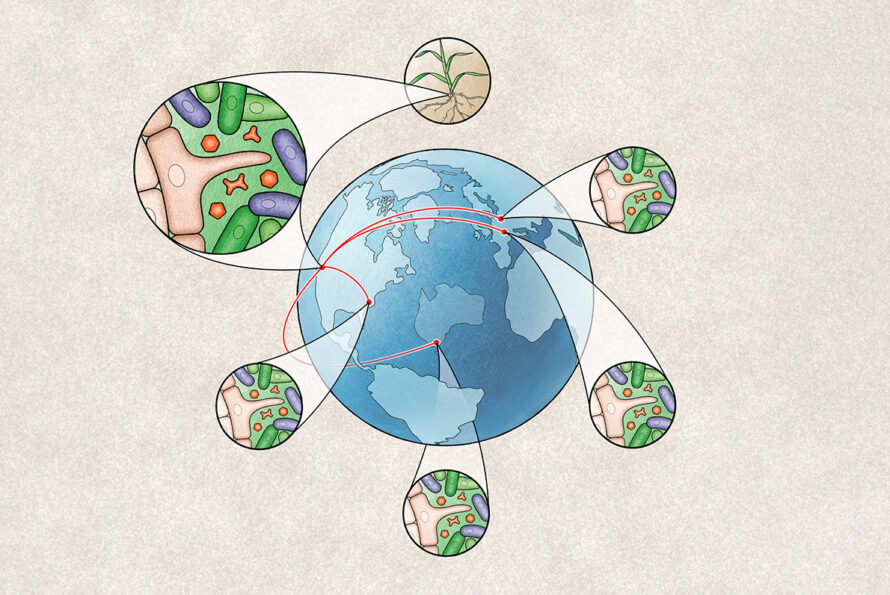
By using standardized EcoFABs, researchers in the EGSB Division and the Joint Genome Institute (JGI) led the team that successfully demonstrated the ability to replicate plant-microbiome studies in five independent laboratories across three continents. The collaborators were tasked with running the exact same synthetic microbiome experiment. Using the EcoFABs, all five observed identical changes in plant growth, root chemistry, and bacterial community structure. They consistently replicated how a specific bacterium, Paraburkholderia, shifted the microbiome—proving that when the environment is perfectly controlled, complex biology can be reliably reproduced anywhere in the world. EcoFAB 2.0 devices can be accessed at no cost by scientists through the JGI’s Community Science Program and the Facilities Integrating Collaborations for User Science (FICUS) call, which are proposal-based initiatives that select projects based on scientific merit and Department of Energy relevance.
“This entire platform is a great example of multi-disciplinary team science,” said Trent Northen, EGSB Deputy Division Director, who also serves as principal investigator of the m-CAFEs Science Focus Area, and co-developer of the EcoFAB and EcoBOT systems. “By using robotics and AI to standardize plant-microbe studies, we are building the foundational tools to accelerate science to address pressing DOE Missions and global challenges.”
By accurately modeling how plants and microbes interact in these standardized environments, Northen says researchers can learn to harness microbiomes to improve soil health and boost agricultural productivity.
Reflecting the true collaborative nature of this work, in addition to Andeer and Noack, Northen credits the platform’s success to critical contributions from a multifunctional team of researchers, including Benjamin Bowen (EGSB), Vlastimil Novak (EGSB), Jamie Sethian (AMCR/CAMERA), Daniela Ushizima (AMCR/CAMERA), John Vogel (JGI), and Petrus Zwart (Molecular Biophysics and Integrated Bioimaging Division/CAMERA), as well as current JGI Lab Automation Staff members LT Cornmesser and Joseph Zorzi.
The development of EcoBOT was supported by several Department of Energy Biological and Environmental Research (DOE-BER) program projects over the years. It was originally developed by the TEAMS initiative, and is now supported by m-CAFEs, the JGI, and TWINS. JGI and NERSC are DOE Office of Science User Facilities.
“By using robotics and AI to standardize plant-microbe studies, we are building the foundational tools to accelerate science to address pressing DOE Missions and global challenges.” – Trent Northen
###
Lawrence Berkeley National Laboratory (Berkeley Lab) is committed to groundbreaking research focused on discovery science and solutions for abundant and reliable energy supplies. The lab’s expertise spans materials, chemistry, physics, biology, earth and environmental science, mathematics, and computing. Researchers from around the world rely on the lab’s world-class scientific facilities for their own pioneering research. Founded in 1931 on the belief that the biggest problems are best addressed by teams, Berkeley Lab and its scientists have been recognized with 17 Nobel Prizes. Berkeley Lab is a multiprogram national laboratory managed by the University of California for the U.S. Department of Energy’s Office of Science.
DOE’s Office of Science is the single largest supporter of basic research in the physical sciences in the United States, and is working to address some of the most pressing challenges of our time. For more information, please visit energy.gov/science.
EcoFABs Could Help Fuel AI in Agriculture
Cracking the Code: Using AI to Solve Difficult-to-Map Proteins