LBNL Masthead A-Z Index Berkeley Lab masthead U.S. Department of Energy logo Phone Book Jobs Search
Search the News Center:
Posts Tagged ‘electronics’

New Path to Flex and Stretch Electronics

December 13, 2011

Berkeley Lab researchers have developed a promising new inexpensive technique for fabricating large-scale flexible and stretchable backplanes using semiconductor-enriched carbon nanotube solutions. To demonstrate the utility of their carbon nanotube backplanes, the researchers constructed an artificial electronic skin device capable of detecting and responding to touch.

MORE>

Partnership for Progress in Electronics Strengthened by New Lab-Industry Investment

December 5, 2011

Through the Center for X-Ray Optics, Berkeley Lab and leading semiconductor manufacturers have mutually invested in major new facilities at the Advanced Light Source for advanced extreme-ultraviolet lithography, including clean rooms, wafer processing facilities, and microlithography test tools too costly for individual manufacturers.

MORE>

A SHARP New Microscope for the Next Generation of Microchips

October 28, 2011

Scientists at Berkeley Lab’s Advanced Light Source and Center for X-Ray Optics are working with colleagues at leading semiconductor manufacturers to build SHARP, the world’s most advanced extreme-ultraviolet-light microscope, to study and design the photolithography masks, materials, patterns, and mask architectures essential to producing the next generation of integrated circuits.

MORE>

An Electronic Bucket Brigade Could Boost Solar Cell Voltages

September 15, 2011

Some ferroelectric materials can develop extremely high voltages when light falls on them, which might greatly improve solar cells if scientists could figure out how they do it. Researchers at Lawrence Berkeley National Laboratory have solved the mystery for one ferroelectric, bismuth ferrite, revealing a principle that should apply to other materials too. The secret is an electronic “bucket brigade” that passes electrons stepwise from one electrically polarized region to the next.

MORE>

Berkeley Lab Scientists Unveil an X-ray Technique Called HARPES

August 24, 2011

Berkeley Lab researchers led the development of a technique called HARPES, for Hard x-ray Angle-Resolved PhotoEmission Spectroscopy, that enables the study of electronic structures deep below material surfaces, including the buried layers and interfaces in nanoscale devices. This could pave the way for smaller logic elements in electronics, novel memory architectures in spintronics, and more efficient energy conversion in photovoltaic cells.

MORE>

A Manganite Changes its Stripes

July 14, 2011

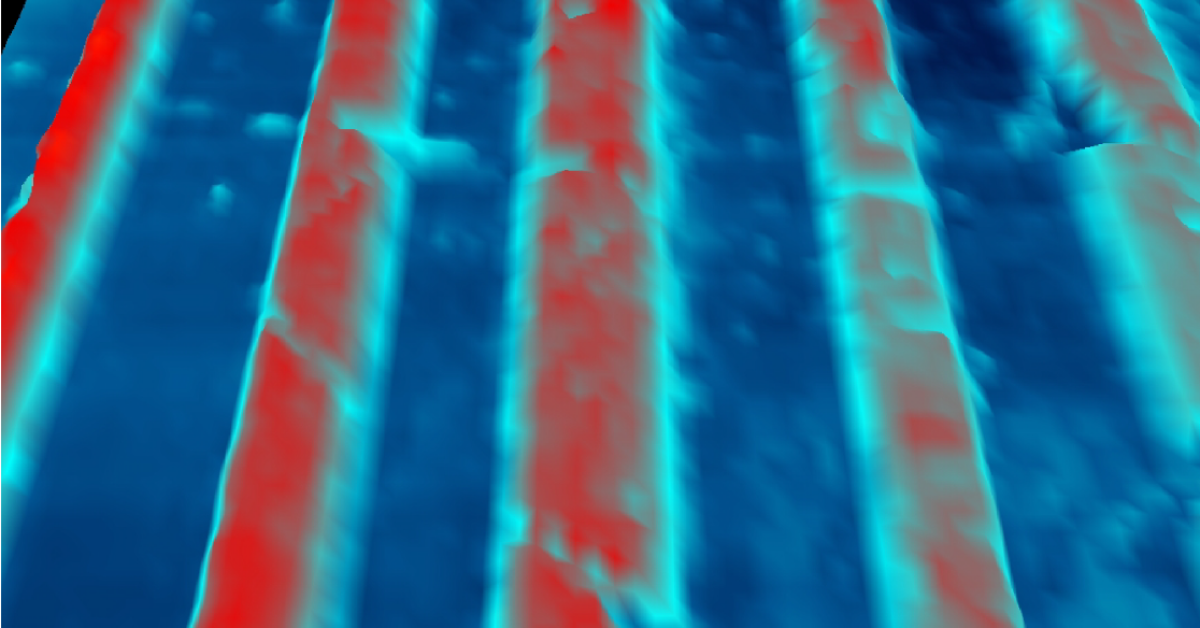
Manganites that exhibit colossal magnetoresistance and well-known high-temperature superconductors are among the materials that show their stripes – regions where electrical charges concentrate. Until now, only static stripes have been seen. At the Advanced Light Source’s beamline 12.0.1, scientists have discovered a manganite whose stripes form or fall apart depending on the temperature, simultaneously giving rise to colossal changes in electrical conductivity.

MORE>

Splitsville for Boron Nitride Nanotubes

June 28, 2011

Berkeley Lab researchers, working with scientists at Rice University, have developed a technique for mass-producing defect-free boron nitride nanoribbons (BNNRs) of uniform length and thickness. BNNRs are predicted to display magnetic and electronic properties that hold enormous potential for future devices.

MORE>

Ultrathin Alternative to Silicon for Future Electronics

November 22, 2010

Berkeley researchers have successfully used ultra-thin layers of the semiconductor indium arsenide to create a nanoscale transistor with excellent electronic properties. The technique could be applied to other III–V semiconductors as well for future high-speed, low-power electronic devices.

MORE>

The Noise About Graphene

October 15, 2010

By studying the ‘noise’ in graphene nanoribbons—one-dimensional strips of graphene with nanometer-scale widths – Berkeley Lab researchers at the Molecular Foundry are moving toward the fabrication of logic switching devices, which are the basis for computation units in today’s computer chips.

MORE>

Plasmonic Promises: First Observation of Plasmarons in Graphene

May 20, 2010

The energy bands of complex particles known as plasmarons have been seen for the first time by scientists working with graphene at the Advanced Light Source. Their discovery may hasten the day when these crystalline sheets of carbon just one atom thick can be used to build ultrafast computers and other electronic, photonic, and plasmonic devices on the nanoscale.

MORE>

A U.S. Department of Energy National Laboratory Operated by the University of California
UC logo
Questions & CommentsPrivacy & Security Notice